First for Wales
Posted: November 18, 2013 Filed under: Homelessness, Legal, Private renting, Regulation, Wales | Tags: Carl Sargeant, Housing, Wales 1 CommentLegislation introduced today marks a historic moment for housing in Wales but it has wider significance for the rest of the UK too.
It makes history by becoming Wales’s first Housing Bill since it acquired greater devolved powers. The Housing (Wales) Bill aims to ‘ensure that everyone in Wales is able to access a decent home’ (though ministers behind all Housing Bills everywhere say that). The details are what count and the timing and the context are what create the wider significance. As Carl Sargeant, the Welsh minister for housing and regeneration, puts it: ‘Despite the impact of austerity measures and budget decisions taken by the UK Government, the Welsh Government is determined to improve the supply, quality and standards of housing and the proposals in this Housing Bill are crucial in achieving this.’
Read the rest of this post on Inside Edge, my blog for Inside Housing
Blaming the planners
Posted: November 11, 2013 Filed under: Housebuilding, Housing market, Mortgages, Planning 1 CommentFix planning and you fix supply, fix supply and you fix the housing crisis. That’s the seductive argument that seems to be gaining ground.
My problem with it is not that it’s wrong. There is a dire shortage of new homes: completions are running at around half what’s needed to meet demand. Problems with the planning system can make supply too slow to respond to demand, constrain growth and make the crisis worse. It would be ridiculous to say otherwise.
It’s more that it’s too simple. It takes a kernel of truth and claims that it is the only truth. In its crudest form the argument is that all we have to do is sweep away ‘socialist’ planning and leave it to the market: in the 1930s there was no planning, private housebuilders were building over 250,000 homes a year and homes were affordable; the post-war Labour government required planning permission for new homes and prices have risen steadily higher ever since because the private sector has been unable to build enough homes.
Help to Buy: Dave’s dream
Posted: November 11, 2013 Filed under: Help to Buy, Housing market, Mortgages Leave a commentDavid Cameron’s cheerleading for the successful launch of the Help to Buy mortgage guarantee scheme unwittingly reveals more than he might have intended.
In a statement issued last night, the prime minister said that 2,384 households have put in offers under the controversial scheme and ten have already completed.
The figures come from applications backed by a decision in principle for 95 per cent mortgages by RBS and Lloyds, the semi-state owned banks. The average advance is £155,000 on homes worth £163,000, which Cameron said demonstrated that Help to Buy is supporting responsible lending.
Read the rest of this post on Inside Edge, my blog for Inside Housing
Universal debit
Posted: November 7, 2013 Filed under: Universal credit, Welfare reform Leave a commentAs we wait for the rescue plan, yet more scathing criticism of the universal credit will surprise nobody.
Today’s report from the Public Accounts Committee is a follow-up to September’s critical review by the National Audit Office but the weight of detail only confirms the impression of a project that long ago spun out of control.
Read the rest of this post on Inside Edge, my blog for Inside Housing
Help to Rent
Posted: November 6, 2013 Filed under: Help to Buy, Housing benefit, Housing market, Private renting Leave a commentFor all today’s headlines about house prices, the most significant claim in new forecasts out today is that private renting will grow by another million households in the next five years.
That is one of the new forecasts for the housing market issued by Savills today and flows from its assumptions on what will happen to house prices. It comes despite the government’s flagship Help to Buy policy that aims to create more owners.
Read the rest of this post on Inside Edge, my blog for Inside Housing
Make a wish
Posted: November 5, 2013 Filed under: Bedroom tax, Housing benefit, Legal, Welfare reform Leave a commentIf ministers thought the furore over the bedroom tax would die down once it was introduced in April, they were sadly mistaken. What they insist on calling the removal of the spare room subsidy has now been in operation for over 200 days and, if anything, the controversy is still growing.
What began as a harsh but arcane cut in housing benefit – the under-occupation penalty or social sector size criteria – has instead forced its way into the public consciousness. As James Green, external affairs manager of the National Housing Federation, explains: ‘When we started our work on the Welfare Reform Bill it seemed like it would be impossible to make it mainstream or get any traction. Now you can go into any pub in the country and say ‘bedroom tax’ and people know what you’re talking about.’
At a political level, it’s become a symbol of the unfairness of the government’s welfare reforms. At the Lib Dem conference, nobody from the party leadership defended one of their own government’s policies. At the Labour conference, Ed Miliband shook off his party’s caution on welfare to pledge that he would repeal it. At the SNP conference, Alex Salmond used the imposition of the bedroom tax from Westminster as a key part of his appeal to the Scottish people to vote for independence. Anecdotal evidence suggests that some Conservative backbenchers are becoming uncomfortable about the policy as they realise its full implications.
Read the rest of my feature on the human, political and legal implications of the bedroom tax at 24 Housing
David Cameron and the £720,000 ‘affordable’ home
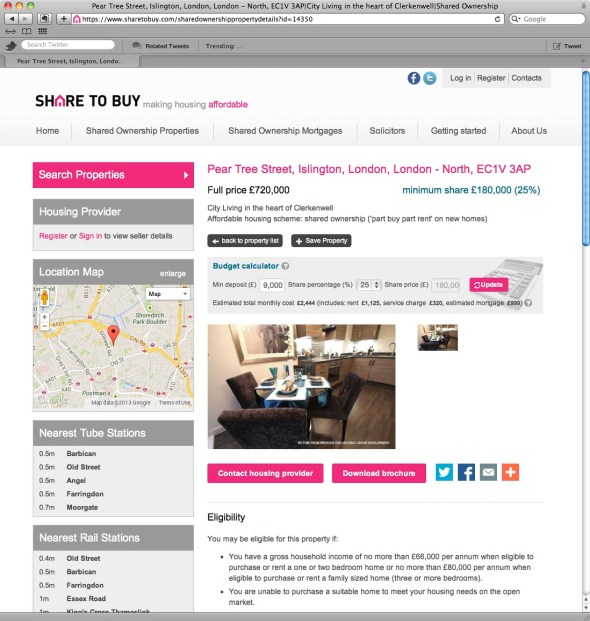
Posted: November 1, 2013 Filed under: Affordable housing, Housebuilding, Planning, Shared ownership Leave a commentA comment on my blog a couple of weeks ago alerted me to a contradiction in terms: a £720,000 ‘affordable’ home.
The two-bedroom flat in Pear Tree Street, Islington appears on the Share to Buy website, the official home of the Mayor of London’s FirstSteps scheme that comes complete with the strapline ‘making housing affordable’. It’s available under a shared ownership, part-rent, part-buy scheme. As Tracy Dover commented: ‘I’d love to know who is eligible for shared ownership and can afford this!’
It can be yours for a £9,000 deposit plus monthly payments of £2,444 for rent, service charge and mortgage. By my calculations that represents around half the take-home pay of a household with the maximum eligible income of £80,000.
Bonus culture
Posted: October 31, 2013 Filed under: Housebuilding, Local government, Planning Leave a commentSo has what started out as ‘a Rolls Royce idea’ ended up ‘a Reliant Robin policy in practice’?
That’s not me describing the New Homes Bonus but Conservative MP Stewart Jackson. Now a member of the public accounts committee (PAC), he was speaking at an evidence session in June ahead of its report published this morning. He was also a shadow communities minister at the time the bonus became a Conservative flagship policy.
With scepticism like that on the Conservative side it’s little wonder that the PAC has more scathing criticism of the handling of the policy. It follows an embarrassing verdict (for the DLCG) delivered by the National Audit Office (NAO) in March.
 Jules Birch