Squeezed out
Posted: May 17, 2013 Filed under: Affordable housing, Housing market, Private renting Leave a commentHere are some thoughts on an event I’ve just chaired for the Resolution Foundation yesterday on the scale of the housing crisis and how to fix it.
Rather like most of my blogs, I thought it would be stronger on the first bit than the second, but the debate revealed a new willingness to look for solutions as well as more reasons to be gloomy.
The centerpiece was a sneak preview of some forthcoming research from the Resolution Foundation and Hometrack on the housing plight of low and middle income households. The foundation is a think tank focused on the 5.6 million people caught in the squeezed middle between stagnating wages and rising costs.
Read the rest of this post on Inside Edge, my blog for Inside Housing
Capital crisis
Posted: February 13, 2013 Filed under: Affordable housing, Homelessness, Housing market Leave a commentThe scale of the housing crisis facing London is hitting home with both Londoners and their political leaders.
In an opinion poll in the Evening Standard published today, half of people in the city say they fear being driven out of their neighbourhood by the cost of housing and six out of ten say there is a crisis in their area.
At one end of the housing scale, soaring demand from global investors is threatening to push house prices even further out of reach of ordinary Londoners. According to a report yesterday from the Home Builders Federation, it now takes the average first-time buyer 24 years to raise a deposit in London.
Read the rest of this post on Inside Edge, my blog for Inside Housing
Deja vu
Posted: November 30, 2012 Filed under: Affordable housing Leave a commentInside Housing’s account of Pat Ritchie’s departure from the HCA only adds to the eerie sense of familiarity that struck me when the news first broke.
According to Nick Duxbury’s story for IH, the interim chief executive turned down the chance to take the job on a permanent basis because the pay was not high enough. The £142,000 salary on offer is lower than other executive salaries at Maple House. It is lower than the £163,904 a year paid to Barry Rowland, who she will succeed as chief executive of Newcastle City Council (a fine city but one that is also facing a budget crisis).
Read the rest of this post on Inside Edge, my blog for Inside Housing
Running a red light
Posted: November 15, 2012 Filed under: Affordable housing, Housebuilding, Housing market Leave a commentHalfway through the parliament and one year in to the housing strategy and the traffic lights seem to be taking for ever to change from red to green for housing.
It also looks like a good time to judge the record of this government and a time to stand back and admit that whoever had been in charge over the last two and a half years would have struggled against the grim backdrop of austerity.
Those are points well made by the CIH, NHF and Shelter in their third Housing Report. The good news is that ministers are at last making the right noises about the positive effects of housing investment but, as the report says, pledges and policies are not proof of progress.
Read the rest of this post on Inside Edge, my blog for Inside Housing
Where’s the evidence on section 106?
Posted: November 7, 2012 Filed under: Affordable housing, Housebuilding, Planning Leave a commentThe government’s plans on section 106 and affordable housing came under fire from all sides of both houses of parliament this week – and no wonder.
In the Commons, communities secretary Eric Pickles said the Growth and Infrastructure Bill would cut red tape by allowing the renegotiation of ‘economically unrealistic’ section 106 agreements. ‘In our sights particularly are affordable housing requirements that were negotiated at the height of Labour’s unsustainable housing boom. Now that the Brown bubble has burst, bringing us back to reality with a bump, we recognise that 75,000 homes, with planning permission, are lying unbuilt.’
Read the rest of this post on Inside Edge, my blog for Inside Housing
Supply and demand
Posted: November 1, 2012 Filed under: Affordable housing, Housebuilding, Housing benefit, Private renting Leave a commentThere is good news, bad news and really bad news in figures out today on housing supply in England.
The good news first: net additional housing supply rose 11 per cent in 2011/12 to 134,900 in 2011. That follows three consecutive annual falls in the wake of the credit crunch and represents a return to the level seen in the early 2000s. Net additional supply is the government’s preferred measure since it includes not just new build homes but gains and losses from demolitions and conversions of buildings from one use to another too.
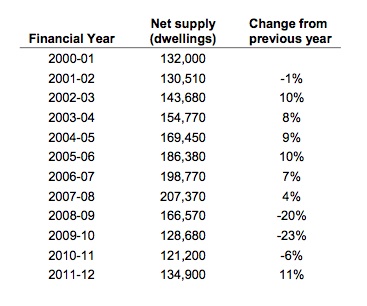
Net additional housing supply in England (source: DCLG)
Home truths
Posted: October 22, 2012 Filed under: Affordable housing, Housebuilding, Private renting Leave a comment‘We’re not in any way complacent,’ Mark Prisk told the Today programme this morning – having spent his interview being just that.
It’s the first time I’ve caught a media appearance by the successor to Grant Shapps, who was so ever-present in the radio and TV studios that he was dubbed the minister for Daybreak. Prisk is not on twitter either so other than a few brief interviews and a few blogs he is still a bit of a mystery to me.
Read the rest of this post at Inside Edge, my blog for Inside Housing
Hidden costs
Posted: October 15, 2012 Filed under: Affordable housing Leave a commentBit by bit the facts about the affordable rent programme are leaking out but far too much remains hidden or unclear.
On Friday, in the typically under-stated style of all-party committees, MPs published their verdict so far. The public accounts committee concludes that ‘it is not yet clear whether the programme will deliver value for money in the long term’ and that ‘the department needs to do more work to understand the impact of the programme on tenants and its interaction with wider welfare reforms’.
Read the rest of this post on Inside Edge, my blog for Inside Housing
 Jules Birch