Garden griping
Posted: January 20, 2014 Filed under: Housebuilding, Planning | Tags: garden cities Leave a commentSo Nick would like two, Eric (through clenched teeth) one or two, Emma five and Boris none. It’s time to play the garden cities game.
A quick look at the electoral map of constituencies around London tells you most of what you need to know about the politics involved. You’ll find a sea of Tory blue in the swathe of seats closest to the capital with only Labour Slough, Luton and Oxford and Lib Dem Lewes and Colchester anywhere near to being affected.
It also explains why David Cameron’s interest has waned and a government-commissioned study on new towns has allegedly been blocked. According to the FT, a Downing Street official has even joked that the only possible sites should be Buckingham and Mid Bedfordshire, the seats of Tory outcasts John Bercow and Nadine Dorries.
Read the rest of this post on Inside Edge, my blog for Inside Housing
Bald truths
Posted: January 9, 2014 Filed under: Housebuilding Leave a commentLike bald men with a comb, the politicians squabbled yesterday over who has the worst record on housebuilding.
The ghost of Stanley Baldwin occupied the green benches once again as Hilary Benn and Eric Pickles traded stats to show that each other’s governments had built the fewest new homes (in England) since the 1920s.
So where Benn opened the opposition debate with the accusation that ‘in the three years for which he has been in charge, the number of homes completed in England has fallen to its lowest level since Stanley Baldwin was first prime minister’, Pickles countered with ‘when I walked through the door of Eland House the spirit of Stanley Baldwin and those figures met me. That was our baseline—that is what we actually started from.’
Read the rest of this post on Inside Edge, my blog for Inside Housing
10 things about 2013: part 2
Posted: December 30, 2013 Filed under: Buy to let, Help to Buy, Housebuilding, Housing market, Labour market, Planning, Private renting, Wales | Tags: Budget George Osborne, David Cameron Leave a commentHere’s the second part of my look back at the key themes I’ve been blogging about this year.
6) Help to Buy
If the bedroom tax was the subject I blogged about most in 2013 (see Part 1 of this blog), Help to Buy was certainly the best (or worst) of the rest.
The first hints of the scheme came in January as the coalition published its Mid-Term Review. Perhaps conscious of the gap between rhetoric and reality when it came to the government’s record on housing, David Cameron promised more help for people who cannot raise a deposit for a mortgage, with details to come in the Budget. By March Cameron and Clegg were promising what sounded to me like the coalition’s fourth housing strategy in three years. And in the Budget George Osborne duly announced what I called a huge gamble, loosening the targeting of previous schemes at first-time buyers and new homes and extending the help available much further up the income scale.
Taking the pledge
Posted: December 17, 2013 Filed under: Housebuilding, Planning | Tags: Conservative Party, Ed Miliband Leave a commentThe optimist in me hopes that Ed Miliband’s launch of Labour’s independent housing commission marks the start of a political arms race on housing ahead of the next election.
In this scenario, his target of 200,000 homes a year by 2020 and eye-catching policies to achieve it will strengthen the hand of the pro-development wing of the Conservative Party and mean that whoever wins the next election will have a serious crack at tackling the supply crisis.
The pessimist in me worries that I’ve seen little so far that suggests the target is achievable (see Colin Wiles on this last week) and that the two policies that have made the headlines won’t work except in the sense of strengthening the hand of the Tory nimbys.
Read the rest of this post on Inside Edge, my blog for Inside Housing
City limits
Posted: November 26, 2013 Filed under: Affordable housing, Housebuilding, Local government, Planning 1 CommentToday’s Draft London Housing Strategy is the boldest attempt yet seen from a Conservative administration to get to grips with the housing crisis. It still does not go remotely far enough.
In his foreword, mayor Boris Johnson says London is facing an ‘epic challenge’ of building more than 42,000 new homes a year, every year, for 25 years. Of these, 15,000 would be affordable and 5,000 for market rent.
That is no exaggeration. As he goes on to say, that is ‘a level of housebuilding unseen in our great city since the 1930s’. To put it in perspective, the average over the last 20 years, at a time when the population was growing rapidly, was 18,000 per year. London has not come close to 42,000 completions a year since the war, even at the peak of the council housing boom in the late 1960s.
Read the rest of this post on Inside Edge, my blog for Inside Housing
Blaming the planners
Posted: November 11, 2013 Filed under: Housebuilding, Housing market, Mortgages, Planning 1 CommentFix planning and you fix supply, fix supply and you fix the housing crisis. That’s the seductive argument that seems to be gaining ground.
My problem with it is not that it’s wrong. There is a dire shortage of new homes: completions are running at around half what’s needed to meet demand. Problems with the planning system can make supply too slow to respond to demand, constrain growth and make the crisis worse. It would be ridiculous to say otherwise.
It’s more that it’s too simple. It takes a kernel of truth and claims that it is the only truth. In its crudest form the argument is that all we have to do is sweep away ‘socialist’ planning and leave it to the market: in the 1930s there was no planning, private housebuilders were building over 250,000 homes a year and homes were affordable; the post-war Labour government required planning permission for new homes and prices have risen steadily higher ever since because the private sector has been unable to build enough homes.
David Cameron and the £720,000 ‘affordable’ home
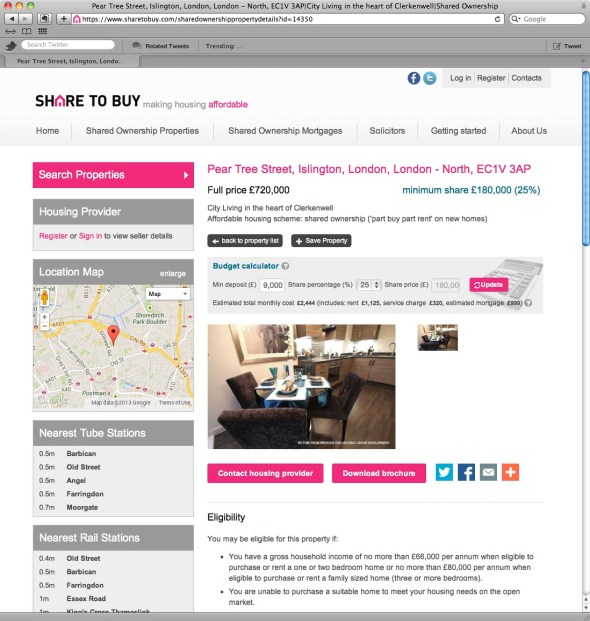
Posted: November 1, 2013 Filed under: Affordable housing, Housebuilding, Planning, Shared ownership Leave a commentA comment on my blog a couple of weeks ago alerted me to a contradiction in terms: a £720,000 ‘affordable’ home.
The two-bedroom flat in Pear Tree Street, Islington appears on the Share to Buy website, the official home of the Mayor of London’s FirstSteps scheme that comes complete with the strapline ‘making housing affordable’. It’s available under a shared ownership, part-rent, part-buy scheme. As Tracy Dover commented: ‘I’d love to know who is eligible for shared ownership and can afford this!’
It can be yours for a £9,000 deposit plus monthly payments of £2,444 for rent, service charge and mortgage. By my calculations that represents around half the take-home pay of a household with the maximum eligible income of £80,000.