Dynamic duo
Posted: March 6, 2013 Filed under: Housebuilding, Housing market, Mortgages, Private renting Leave a commentSo will the next big housing announcement from David Cameron and Nick Clegg amount to any more than the last three?
The Financial Times reported yesterday that the coalition double act are ‘drawing up schemes to revive the flatlining housebuilding industry and help people get on the housing ladder’. On the eve of the Budget on March 20 they will make a series of announcements including measures on shared equity schemes, social housing and support for first-time buyers.
Despite the scoop, even the FT admits that this ‘may be treated with some scepticism given that such announcements on housebuilding have become a regular feature of the coalition – while the industry has continued to stagnate’.
Read the rest of this post on Inside Edge, my blog for Inside Housing
False start
Posted: February 22, 2013 Filed under: Housebuilding Leave a commentIt’s half time for a government that promised to make us ‘a nation of homebuilders’. The crowd are – to put it mildly – not happy.
Figures released yesterday show the performance of the coalition in the first two and a half years of its five-year term. By now its abolition of ‘Stalinist’ top-down regional strategies and creation of the ‘powerful new incentive’ of the new homes bonus and the National Planning Policy Framework should be working.
Instead housebuilding in England is flat-lining at less than half of the level required. The 26,830 housing starts in the fourth quarter of 2012 were up by 180 on the previous three months but down by 400 on a year ago.
Read the rest of this post on Inside Edge, my blog for Inside Housing
Nudging the nimbys
Posted: January 10, 2013 Filed under: Housebuilding, Planning 5 CommentsThe minister introduces a ‘powerful new incentive’ for local communities to approve new homes. Sound familiar?
I am of course not talking about planning minister Nick Boles and his scheme to give local communities a share of the community infrastructure levy but former housing minister Grant Shapps and the new homes bonus.
As quickly became clear, this wasn’t a bonus and it didn’t have much to do with new homes either. It was more a mechanism for creating winners and losers (affluent areas and deprived ones). In the year before the first payments were made, there were a miserable 113,000 housing starts in England. In the year after, there were 105,000.
So what’s the difference between the Shapps Sweeteners and the Boles Bungs? The planning minister could quite reasonably point out that his cash will get closer to local communities because it will go to parish and town councils whereas the bonus goes to local authorities. In theory at least that should cut out the middle man and make the bribe more persuasive.
Running a red light
Posted: November 15, 2012 Filed under: Affordable housing, Housebuilding, Housing market Leave a commentHalfway through the parliament and one year in to the housing strategy and the traffic lights seem to be taking for ever to change from red to green for housing.
It also looks like a good time to judge the record of this government and a time to stand back and admit that whoever had been in charge over the last two and a half years would have struggled against the grim backdrop of austerity.
Those are points well made by the CIH, NHF and Shelter in their third Housing Report. The good news is that ministers are at last making the right noises about the positive effects of housing investment but, as the report says, pledges and policies are not proof of progress.
Read the rest of this post on Inside Edge, my blog for Inside Housing
Where’s the evidence on section 106?
Posted: November 7, 2012 Filed under: Affordable housing, Housebuilding, Planning Leave a commentThe government’s plans on section 106 and affordable housing came under fire from all sides of both houses of parliament this week – and no wonder.
In the Commons, communities secretary Eric Pickles said the Growth and Infrastructure Bill would cut red tape by allowing the renegotiation of ‘economically unrealistic’ section 106 agreements. ‘In our sights particularly are affordable housing requirements that were negotiated at the height of Labour’s unsustainable housing boom. Now that the Brown bubble has burst, bringing us back to reality with a bump, we recognise that 75,000 homes, with planning permission, are lying unbuilt.’
Read the rest of this post on Inside Edge, my blog for Inside Housing
Supply and demand
Posted: November 1, 2012 Filed under: Affordable housing, Housebuilding, Housing benefit, Private renting Leave a commentThere is good news, bad news and really bad news in figures out today on housing supply in England.
The good news first: net additional housing supply rose 11 per cent in 2011/12 to 134,900 in 2011. That follows three consecutive annual falls in the wake of the credit crunch and represents a return to the level seen in the early 2000s. Net additional supply is the government’s preferred measure since it includes not just new build homes but gains and losses from demolitions and conversions of buildings from one use to another too.
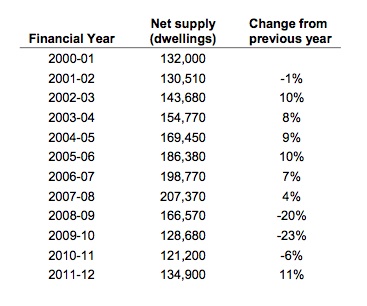
Net additional housing supply in England (source: DCLG)

