Supply and demand
Posted: November 1, 2012 Filed under: Affordable housing, Housebuilding, Housing benefit, Private renting Leave a commentThere is good news, bad news and really bad news in figures out today on housing supply in England.
The good news first: net additional housing supply rose 11 per cent in 2011/12 to 134,900 in 2011. That follows three consecutive annual falls in the wake of the credit crunch and represents a return to the level seen in the early 2000s. Net additional supply is the government’s preferred measure since it includes not just new build homes but gains and losses from demolitions and conversions of buildings from one use to another too.
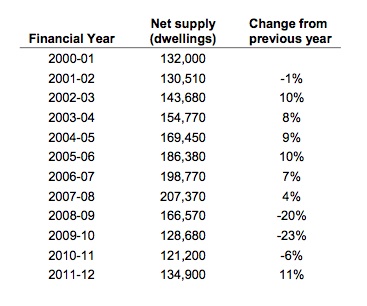
Net additional housing supply in England (source: DCLG)
Red flags
Posted: October 30, 2012 Filed under: Housing benefit, Poverty, Welfare reform Leave a commentAs the slow motion train crash of welfare reform continues, the driver is ignoring a succession of people desperately waving as he passes them.
Heedless of the big red flags they are holding, Iain Duncan Smith and his conductor Lord Freud sometimes even wave back and blow the whistle of their sleekly designed train in acknowledgement of what they see as the congratulations of the crowd.
Read the rest of this post on Inside Edge, my blog for Inside Housing
Rent spiral
Posted: October 19, 2012 Filed under: Housing benefit, Private renting Leave a commentRemember when David Cameron claimed that housing benefit cuts were bringing down rent levels? I bet he doesn’t now either.
Cameron said at prime minister’s questions in January that: ‘What we have seen so far, as housing benefit has been reformed and reduced, is that rent levels have come down, so we have stopped ripping off the taxpayer.’
Read the rest of the rest of this post on Inside Edge, my blog for Inside Housing.
Sound of silence
Posted: October 9, 2012 Filed under: Housing benefit, Welfare reform | Tags: welfare cuts Leave a commentAmid all the rhetoric about those £10 billion cuts in welfare, what’s not being said could ultimately turn out to be more significant.
We’ve become so accustomed to welfare cuts that it’s easy to assume that another £10 billion is just more of the same. It isn’t and it is not at all clear where the savings will come from.
Read the rest of this post on Inside Edge, my blog for Inside Housing
Strivers and scroungers
Posted: October 7, 2012 Filed under: Housing benefit 4 CommentsIn place of Labour’s ‘One Nation’, David Cameron today gave us two – with housing as the dividing line between them.
In an interview with Andrew Marr ahead of the opening of the Conservative conference he repeatedly pressed home the party’s appeal to ‘strivers’. ‘This week here in Birmingham you’re going to hear in huge detail how we get behind people who want to get on and want to make something of their lives,’ he said. ‘That’s what it’s about.’
He also signalled more cuts in welfare before the next election, despite ruling out the mansion tax that Nick Clegg has said will be the price of Lib Dem support for them. The most striking thing for me about the interview was the way that Cameron repeatedly used housing benefit as a proxy for the welfare system as a whole.
Model theory
Posted: July 10, 2012 Filed under: Affordable housing, Housing benefit Leave a commentSo is affordable rent value for money? After two hours of scrutiny from MPs we are still not much closer to an answer.
What seems clear is that between them the DCLG, HCA and housing sector have done a pretty good job of making the best of a grim situation up to 2015. What is far from clear is what that means over the next 10, 20 or 30 years.
The influential public accounts committee spent yesterday afternoon questioning experts from the sector plus Sir Bob Kerslake of the DCLG and Margaret Ritchie of the HCA. This follows publication of a report on the affordable rent programme by the National Audit Office that, as I blogged last week, left several key questions about the programme unanswered. By my reckoning I now have partial answers to two out of five questions, some more information on another two but an even more confused picture on the fifth.
Final answer?
Posted: July 4, 2012 Filed under: Affordable housing, Housing benefit Leave a commentThe verdict from the National Audit Office (NAO) on the affordable rent programme is generally positive but it still leaves several key questions unanswered.
The financial watchdog says that the DCLG has ‘so far achieved its policy objective to maximise the number of homes delivered within the available grant funding’. Grant per home was a third of previous levels, the programme was over-subscribed and 80,000 homes are being delivered against an initial target of 56,000.
The NAO concludes that:
‘The Department and the [Homes and Communities] Agency selected a design for the Programme that is projected to maximise benefits and the number of homes delivered within the constraints of the £1.8 billion capital funding available. The launch of the Programme has been successful. Providers have committed to building some 80,000 homes for the £1.8 billion of government investment, approximately 24,000 more homes than first expected. In this respect, the Programme has made a good start.’
So far, so good but the NAO also reveals several risks:
- 18 per cent of contracts had not been signed as at April 2012 (mostly local authorities that needed to confirm their borrowing capacity following HRA reform)
- more than half of the homes are planned for the final year of the programme ‘so slippage would put at risk achievement…of the planned 80,000 homes’
- some providers in London are worried they will not be able to charge the rents they originally agreed
- the DCLG needs to carry out ‘a thorough analysis of the financial position of providers to assess the repeatability’ of the programme after 2015.
In the process, the report reveals details about the programme that I at least have not seen before but it also begs some more questions.
Speech marks
Posted: June 25, 2012 Filed under: Housing benefit, Welfare reform Leave a commentIt would be easy to criticise the ideas in David Cameron’s speech on welfare reform as half-baked and impractical. They are both but that is not the main point.
One paragraph is missing from the transcript of the speech he gave in Kent today. This is a reference by Cameron to the way that the last Labour government allegedly ran up ‘a huge income transfer industry that they ran from the Treasury pushing tax credits and benefits around in a bid to try hit the poverty targets they’d set up’. This is marked as ‘political content excised’.
It’s a label that might as well apply to the whole speech, given that it’s a vision of what the welfare system would look like under a Conservative, Liberal Democrat-free government. You don’t have to look very far today to find Lib Dem bloggers calling on Nick Clegg to condemn Cameron’s ideas in the strongest language imaginable’ and Lib Dem think-tanks calling them ‘daft’ and ‘unworkable’.
Read the rest of this post on Inside Edge, my blog for Inside Housing.
Hidden reality
Posted: May 29, 2012 Filed under: Homelessness, Housing benefit Leave a commentIf you missed Britain’s Hidden Homeless last night it’s well worth making time to catch on iPlayer.
The BBC documentary was presented by Speech Debelle, the Mercury-prize winning rapper with personal experience of what she was talking about. She spent three years sofa surfing and in hostels after falling out with her mum at 19 and wrote the opening song of what went on to be her prize-winning first album while in a hostel.
So this was far more than the standard celeb-fronted BBC3 documentary. You believed her when she said that hidden homelessness is three times bigger than the official figures suggest and that things are worse now than they were for her ten years ago.
Read the rest of this post on Inside Edge, my blog for Inside Housing.
Welfare reform Mark 2
Posted: May 16, 2012 Filed under: Housing benefit, Welfare reform 3 CommentsWith (depending on your point of view) neat or cruel irony the number of part-time employees hit a record high within hours of them being identified as a major target for a second round of welfare reform.
Official figures published on Wednesday morning confirmed that unemployment fell by 45,000 to 2.63 million people and the number of people in work rose by 105,000. However, within that total the number of people working part-time because they cannot find full-time work rose to a record high of 1.4 million. There are now eight million part-time employees and 4.2 million self-employed people – both the highest numbers since records began in 1992.
 Jules Birch