Middle way
Posted: July 19, 2013 Filed under: Private renting Leave a commentA call to force letting agents be upfront about their charges has made all theheadlines but a report published by MPs today is about much more than that.
After complaints from both tenants and landlords about a sector dubbed ‘the property industry’s Wild West’, the cross-party Communities and Local Government committee recommends going further than the government’s plan to require letting agents to belong to an approved redress scheme. They say it should be accompanied by ‘a robust cost of practice that sets out clear standards with which agents are required to comply’ and they recommend that letting and managing agents should be subject to the same regulation – and required to meet the same professional standards – as sales agents.
Read the rest of this post on Inside Edge, my blog for Inside Housing
Missing millions
Posted: July 17, 2013 Filed under: Housebuilding Leave a commentSo where are the 250,000 homes going to come from? And what are the consequences of not building them?
Almost ten years after the Barker review set that benchmark for housing provision in England to keep house price inflation under control, a new report out from Shelter points out that we are already a million homes behind. If we carry on building at today’s miserable levels the shortfall will rise by another million homes every six and a half years.
In Getting Serious About the Housing Shortage, Matt Griffith and Pete Jefferys argue this would mean accepting a continued fall in home ownership and an ever-rising housing benefit bill while increasing individual and national vulnerability to economic shocks.
Read the rest of this post on Inside Edge, my blog for Inside Housing
Leap of faith
Posted: July 15, 2013 Filed under: Housing benefit, Welfare reform Leave a commentReturning from holiday this morning to hear Iain Duncan Smith mouth half-truths and dodgy stats about benefits on the Today programme it felt like I had never been away.
The work and pensions secretary was speaking as the overall benefit cap was introduced in another 335 local authority areas from today. The remaining 40 most affected areas will follow next month.
In an astonishing interview IDS packed in so many questionable claims that it seemed he was determined to establish a decisive lead in the Department for Work and Pensions (DWP) game of dodgy stats bingo.
Read the rest of this post on Inside Edge, my blog for Inside Housing
Happy birthday welfare state
Posted: June 29, 2013 Filed under: Health, History, Welfare state Leave a commentThis Friday marks the 65th anniversary of one of the greatest moments in British history. With some justification, it has been called ‘our second Finest Hour’.
But as the welfare state and the National Health Service reach retirement age are both of them being pensioned off by a government intent on austerity and endless rounds of welfare and public sector ‘reform’?
Monday, July 5, 1948 was known as The Appointed Day. It marked not just the start of the NHS but also full implementation of the Beveridge plan for social security. A comprehensive system of national insurance now complemented earlier measures including family allowances and industrial injuries compensation.
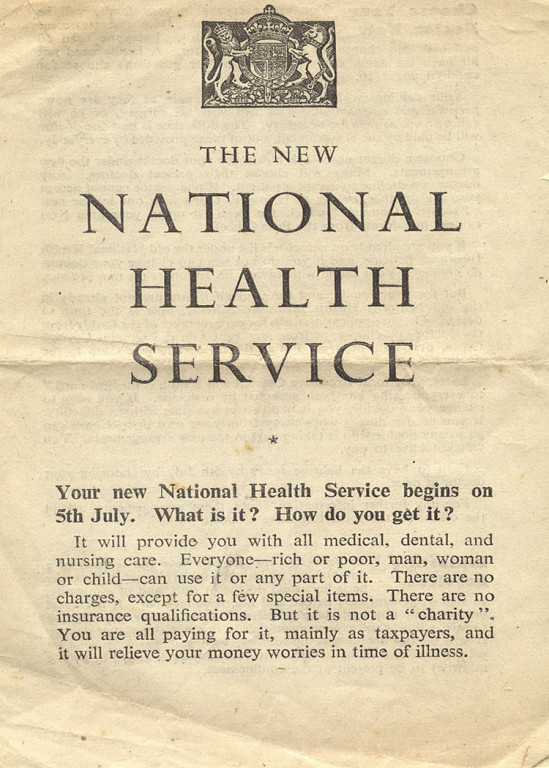
The NHS launch leaflet, July 1948
Personal testimonies of the time range from the touching to the gruesome and the comical to the romantic. One young GP remembered going to see a family where he’d left medicine for a sick child. As he was leaving he heard coughing and asked the mother if she wanted him to go up. ‘I’m sorry, doctor, we can’t afford it,’ she said, explaining that it was another child who was ill. ‘Today, July 5th, it’ll cost you nothing, I was able to tell her,’ he said. ‘And I’ve never forgotten it.’
Own goal
Posted: June 17, 2013 Filed under: Help to Buy, Housing market, Mortgages Leave a commentAs average asking prices pass £250,000 for the first time, two-thirds of the under-45s seem to have given up on the idea of ever owning a home.
Two surveys out today underline the point that what’s ‘good news’ for existing owners is exactly the opposite for people struggling to get on to the housing ladder.
Rightmove says that the market in the ‘under-priced’ (its word not mine) South East has ‘lifted off’ with asking prices rising by 14.8 per cent in the first six months of 2013 alone. However, the average increase across England and Wales is 10.4 per cent and the increase is even 5.8 per cent in the least buoyant region, the East Midlands.
If anything like that was repeated across the whole 12 months, 2013 would be appear to be set for a boom unlike anything seen since the credit crunch hit in 2007. True these are asking prices and prices actually achieved are still in the relative doldrums but they indicate that existing owners are reacting predictably to the start of Help to Buy by ramping up their demands.
Contrast that with another survey out today from the Halifax.
Read the rest of this post on Inside Edge, my blog for Inside Housing
Decline and fall
Posted: June 4, 2013 Filed under: Uncategorized Leave a commentCoalition ministers rarely fail to taunt Labour with the fact that the number of affordable homes fell under the last government.
Conservative housing minister Mark Prisk and Lib Dem junior communities minister Don Foster deployed it yet again at DCLG questions yesterday.
Labour’s Jack Dromey attacked the government’s record on housebuilding and called for a rejection of the ‘economic illiteracy of austerity, which is pushing up the costs of failure through additional borrowing and soaring housing benefit bills’. He asked: ‘Does the housing minister agree that the time has come to invest in badly needed social and affordable homes to rent or buy, creating jobs and apprenticeships, bringing down the costs of failure and getting our economy moving?’
In response Foster was quick to deploy the favourite stat:
‘I think that the whole House will have been somewhat amused by the cheek of the hon. Gentleman, given that under his party’s administration we saw a reduction of 421,000 in the number of affordable homes. This government have introduced measures to reverse that trend, and we hope to announce further measures in the near future.’

