Net zero u-turn leaves tenants paying the bills
Posted: September 26, 2023 Filed under: Energy efficiency, Private renting Leave a commentOriginally written as a column for Inside Housing.
The clue is in Rishi Sunak’s language. This is about more than just his claim to be putting ‘the long-term interests of our country before the short-term political needs of the moment’ when he is doing the opposite.
Nor even his pledge to scrap a range of ‘worrying proposals’ on bins, flights and car-sharing that have never actually been proposed.
No, the obfuscation in his speech last week on net zero really becomes clear when you look at the details with the biggest implications for housing.
‘Under current plans, some property owners would’ve been forced to make expensive upgrades in just two years’ time,’ he said.
Some property owners? Who could he mean? The prime minister cannot bring himself to say private landlords because they simply do not fit in with his narrative of Westminster imposing ‘significant costs on working people especially those who are already struggling to make ends meet’.
Because his announcement actually does the complete opposite. The plan to tighten Minimum Energy Efficiency Standards (MEES) for private rented homes would have saved millions of tenants £220 a year on average according to the government’s own impact assessment.
Read the rest of this entry »Housing and the cost of living
Posted: September 20, 2023 Filed under: Cost of living, Housing market, Private renting, Rents, Social housing Leave a commentOriginally written as a column for Inside Housing.
Inflation is starting to fall at last but the chances are what you pay for your housing has gone up along with the cost of everything else.
But this week’s inflation figures got me thinking about what we really mean by ‘inflation’ and how rising prices work differently in different tenures.
For starters, it all depends on the measure you use. The Consumer Price Index (CPI) is the one in the Bank of England’s inflation mandate so it matters most to its decisions on whether to raise interest rates or not.
CPI inflation affects the Bank’s decisions on interest rates which in turn drives mortgage rates so it is good news that it fell to 6.7 per cent in the year to August. However, CPI does not include owner-occupiers’ housing costs and it is not the index favoured by the Office for National Statistics (ONS).
If you’re not confused yet, on the ONS’s favoured measure of CPIH (which includes owner-occupier housing costs and council tax) inflation fell to 6.3 per cent in the year to August.
However, those costs are based on an estimate of the equivalent rents that owner-occupiers would be paying. There may be sound economic arguments for excluding rising asset values from the inflation calculation but rising house prices still mean rising housing costs for home owners that are ignored.
Old-style Retail Price Index (RPI) inflation – also falling but still considerably higher at 9.1 per cent – is the only measure that directly includes mortgage interest payments but is seen as less accurate than CPI and is no longer treated as on official statistic by the ONS. Despite that, RPI is still used to set price increases in some leases.
For all the differences between the three measures, it does seem clear that rising costs for renters and owners are playing an increasingly important role in inflation in household costs as the impact of the huge hikes in gas and electricity prices starts to recede. This ONS graph illustrates that only too clearly:

But what is really happening to house prices and rents? It all depends on who you believe.
Read the rest of this entry »Is there a landlord exodus?
Posted: August 10, 2023 Filed under: Private renting Leave a commentOriginally written as a column for Inside Housing.
More pain for renters as landlords look to sell up. Renters compete with 20 others in battle to find a home.
Take even a casual glance at headlines about the dire state of the private rented sector and you come away with the impression that there is an exodus of landlords and that something, anything, must be done to persuade them to stay put.
The reality is more nuanced and confusing. While tenants are facing a shortage of properties to let and rapidly rising rents in many parts of the country, it is difficult to say why with any certainty.
Landlords face increased costs from rising mortgage rates, reduced tax reliefs and new requirements on the condition of their properties – even if it’s hard to remember them cutting their rents when interest rates fell close to zero after the financial crisis.
But the bigger picture is obscured both by a lack of reliable data and by claims that are either anecdotal or reek of self-interest.
Much of the data that does exist runs counter to the ‘landlord exodus’ narrative (so far, anyway, and there are time lags in the data). Government dwelling stock statistics estimate that the private rented sector grew by 123,000 homes between 2019 and 2022 but the sector has been pretty static since the middle of the last decade.
Read the rest of this entry »Wales consults on right to housing and fair rents
Posted: June 8, 2023 Filed under: Private renting, Rent control, Wales Leave a commentOriginally written as a column for Inside Housing.
The right to housing. Rent regulation. Two of the most prominent big ideas for fixing the housing system have just gone out for consultation in Wales.
There is still a long way to go after publication of what amounts to the lightest of green papers and there is a big difference between proposing something and implementing it. However, taken together they represent a big challenge to current orthodoxy.
The green paper on housing adequacy and fair rents is the result of the cooperation agreement between Welsh Labour and Plaid Cymru. A white paper will follow but this is more of a call for evidence than a definite commitment to action or legislation.
The right to adequate housing is part of a United Nations covenant on economic, social and cultural rights that the UK signed up to almost 50 years ago. However, turning a vague aspiration to ‘housing as a human right’ into something more meaningful means incorporating it into national law, a move with strong support in the housing sector in Wales.
At the same time, as in the rest of the UK, support has been growing on the left and among private renters for some form of rent regulation.
Read the rest of this entry »What’s gone wrong with our housing – and what could go right
Posted: April 4, 2023 Filed under: Private renting, Right to buy, Social housing | Tags: Barcelona, Singapore, Vienna Leave a commentAs symbols of failure, take a former council house in south London chopped up into six bedsits, housing association tenants waiting in vain for repairs and private renters searching non-stop for homes
As a symbols of success, take Vienna’s century of genuinely affordable rents, Barcelona’s long-term housing strategy and Singapore’s melding of the market and public ownership.
The Rental Health series stretching across BBC radio and television had all of that and more, from lots of jobs but no homes in the Highlands to the dire state of the rental market in Yorkshire to the mechanics of local housing allowance and Section 21 to people looking for housing alternatives in vans, co-housing and boats.
Those symbols of failure don’t come much starker than the three-bedroom council house on the Bampton estate in Forest Hill featured in the brilliantly appalling BBC Panorama documentary What’s Gone Wrong With Our Housing?
The first tenant moved into the home in 1971, bought it under the right to buy for £15,000 in 1984 and sold it for £85,000 in 1988. It is now owned by a private landlord who has converted it into six bedsits rented out for £960 a month each.
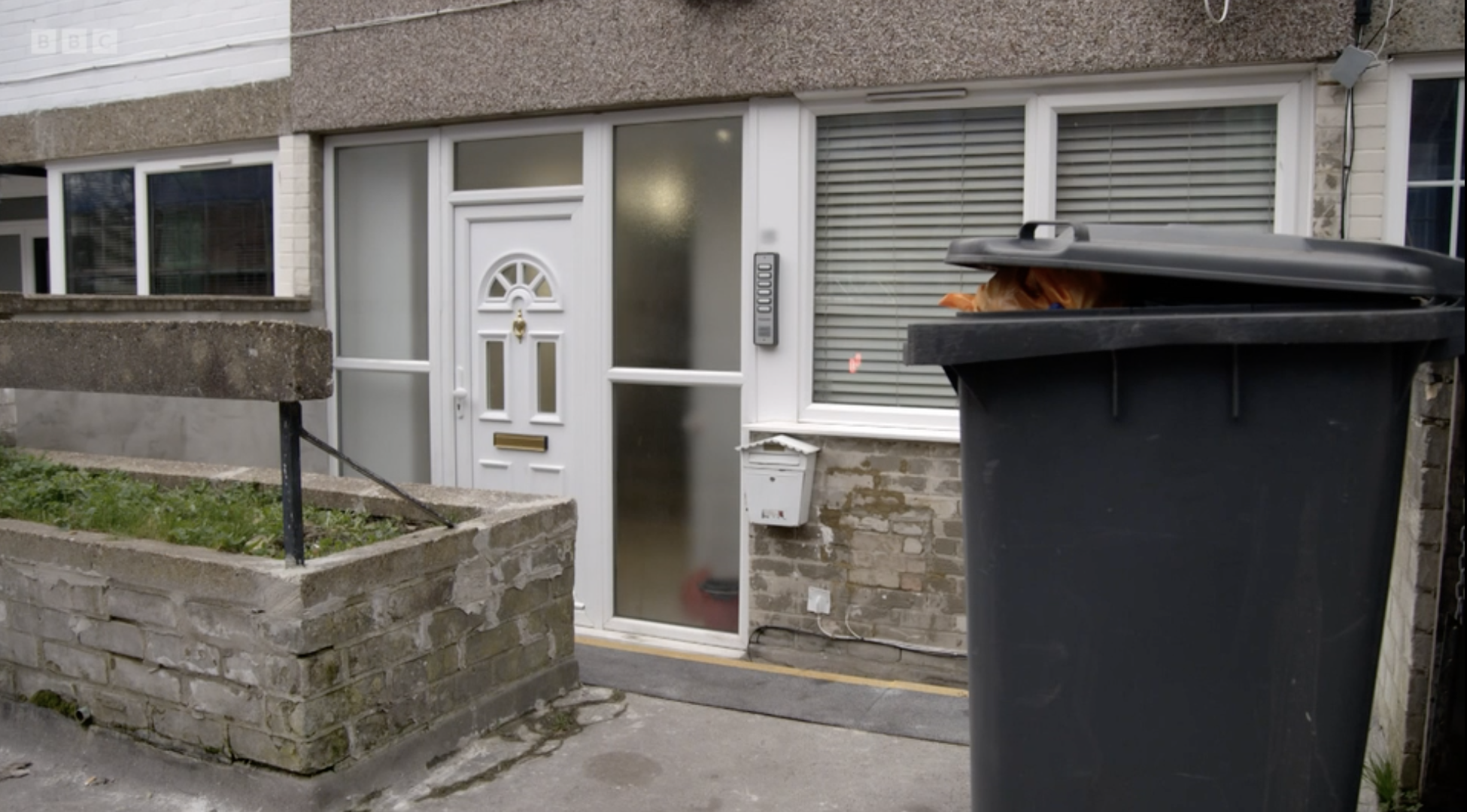
Most of what amounts to £60,000 a year in rent is paid in housing benefit by the government that sold it for a quarter of that.
As if that was not enough to make the point, the same private landlord has done the same thing to three other houses in the same terrace and is pocketing £250,000 a year.
Read the rest of this entry »Waiting for renter reform
Posted: February 9, 2023 Filed under: Local housing allowance, Private renting, Section 21 Leave a commentOriginally written as a column for Inside Housing.
Take your pick. Section 21, housing benefit, tax, net zero, standards, Covid, the courts, mortgage rates, tenants.
All of them reasons why there will be an exodus of landlords and homes from the private rented sector if you believe what you read in certain newspapers. All of them are one more nail in the coffin of buy to let.
One or more of those reasons will be quoted in every article about landlords selling up but, though there may be an element of truth to some of them, few will stop to point out that the party lasted for years. I don’t remember many landlords cutting their rents when mortgage rates fell to record lows after 2009 or complaining about the capital gains they’ve made since.
What matters, as MPs on the all-party Levelling Up, Housing and Communities Committee points out in a report published today [Thursday] is who buys the homes that landlords are selling.
Properties sold to another private landlord, or perhaps to a local authority or social landlord, are still available for rent. Those sold into owner-occupation will reduce demand for rentals if the new owner was previously a renter.
The really damaging destination is when homes for rent are sold, or converted, into short-term holiday lets and that means that the Westminster government must go further than tentative plans for registration.
That’s a powerful reminder that reforming the private rented sector is about much more than ‘greedy landlords’ or a ‘war on buy to let’ and that any new system has to balance different interests and demand from different groups for decent homes to rent.
Read the rest of this entry »Gove’s admission begs more questions
Posted: January 30, 2023 Filed under: Fire safety, Leasehold, Planning, Private renting Leave a commentOriginally written as a column for Inside Housing.
Michael Gove’s admission that ‘faulty and ambiguous’ building regulations set by central government were partly to blame for the Grenfell Tower fire will come as no surprise to anyone who has taken even passing notice of the evidence at the public inquiry.
That a statement so blindingly obvious should be enough to prompt a worried look from one of the levelling up secretary’s media minders speaks volumes about the government’s stance up to now. It also begs significant questions about the administration’s approach to housing going forward.
The admission (and the look) came in an interview with the Sunday Times trailing the announcement on Monday that developers have six weeks to sign legally binding contracts to repair unsafe buildings or, in effect, lose the ability to build anything else.
As the levelling up secretary told Sophy Ridge on Sunday on Sky News: ‘The people who were responsible for erecting buildings which we now know are unsafe have to pay the costs of making sure those buildings are safe.’
Except that making UK-registered developers liable for fixing the blocks they built themselves via the contracts but for paying to fix other buildings via the Building Safety Levy does not really capture all of those responsible.
As the inquiry has revealed, that list includes just about every part of the construction industry, and especially product manufacturers. Mr Gove’s written statement on Monday does say that contractors and manufacturers are among those whose conduct is being investigated by his department’s Recovery Strategy Unit.
The list now also includes a government that Mr Gove says ‘collectively has to take some responsibility’ (meaning current and previous governments).
Read the rest of this entry »Four decades of failure
Posted: January 19, 2023 Filed under: Housing benefit, Rent control, Social housing Leave a commentOriginally written as a column for Inside Housing.
Why has housing become so unaffordable over the last 40 years?
The answer, according to new report for the Joseph Rowntree Foundation (JRF), is cuts in housing subsidy that represent ‘a massive shift in who pays market housing costs, from government and landlords onto tenant’ since 1979.
It’s the scale of the shift, rather than the shift itself, that is striking.
Back at the start of Margaret Thatcher’s first term, social and private renters alike were paying around 10 per cent of their incomes on rent. By 2020 that had risen to 25 per cent for social renters and 30 per cent for private renters.
The shift is represented in a graph that Ian Mulheirn, who co-authored the report with colleagues James Browne and Christos Tsoukalis from the Tony Blair Institute for Global Change, calls ‘one of the most striking’ in public policy:
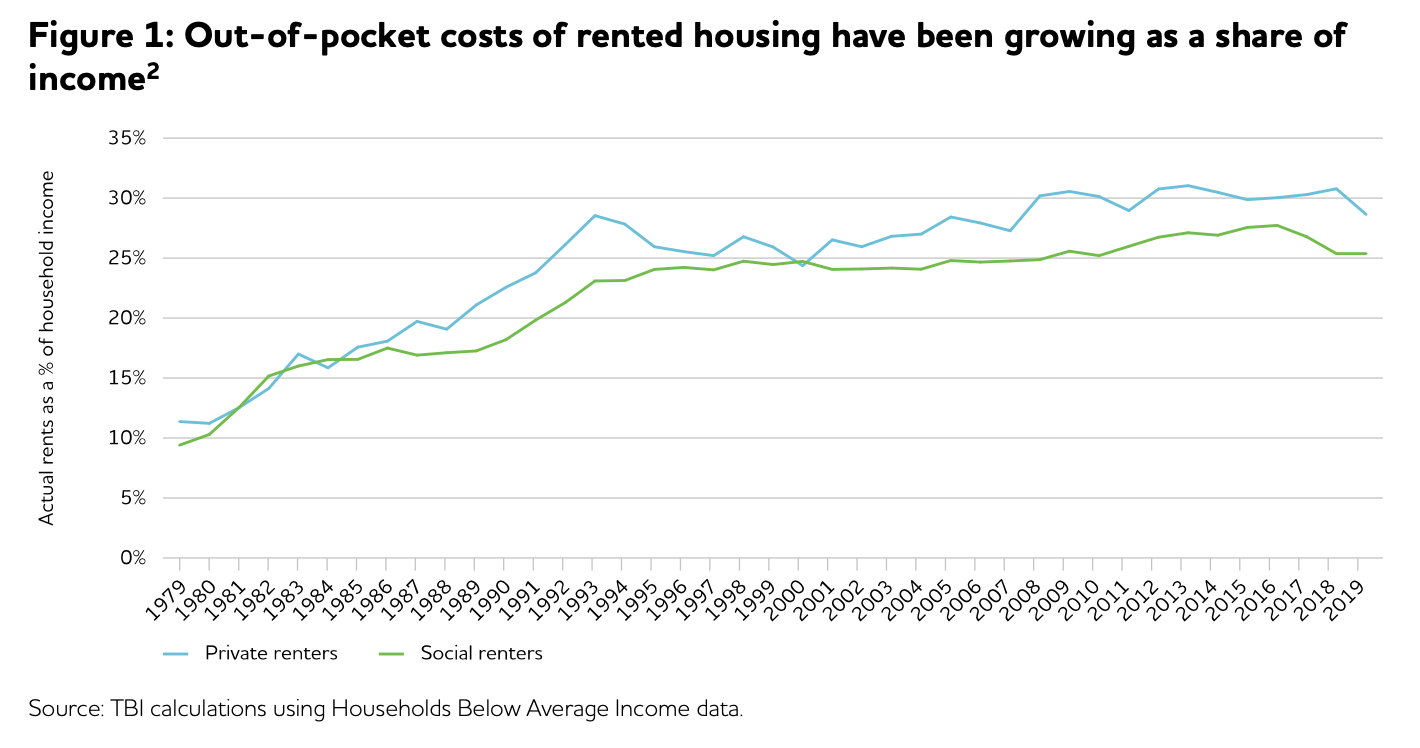
They calculate that if housing subsidies had been maintained at 1979 levels as a share of total housing costs they would have been worth £45 billion 2019/20 rather than the actual £31 billion.
This ‘generational housing costs squeeze’ is the result of massive change in three elements of housing subsidy: social housing; housing benefit; and rent controls.
That is the result of the accumulation of many different policies over time: cuts in investment in council housing and higher council rents; private finance and higher housing association rents; the deregulation of the private rented sector; and rapid increases in housing benefit to ‘take the strain’ of all that followed by the cuts imposed under austerity.
Read the rest of this entry » Jules Birch