Posted: October 4, 2017 | Author: julesbirch | Filed under: Help to Buy, Home ownership, Social housing | Tags: Conservatives, Sajid Javid, Theresa May |
Originally posted as a column for Inside Housing on October 4.
You wait a lifetime for a prime minister to make housing their priority and then she gets her P45 while losing her voice with the conference set falling apart behind her.
With all that happening around her it was easy to ignore the substance of Theresa May’s speech.
You may have missed it between coughs but for the first time since the 1950s here was a prime minister promising to put housing at the heart of their premiership.
And here was a Conservative prime minister not just promising an extra £2bn for ‘affordable’ housing but even allowing bids for social rent too.
But as the letters slowly dropped off the conference slogan about ‘BUILDING A COUNTRY THAT WORKS FOR EVERYONE’ you wondered how long she will have a premiership to put anything at the heart of.
And even then it is hard to avoid drawing the obvious conclusions from the comparison between an extra £2bn for affordable housing and an extra £10bn for Help to Buy.
Read the rest of this entry »
Posted: September 29, 2017 | Author: julesbirch | Filed under: Blogging, Grenfell Tower, Mortgages, Social housing |
Originally posted as a column for Inside Housing on September 28.
When I started blogging for Inside Housing in September 2007 I wondered if I’d find enough to write about.
As it turned out there was no need to worry. A week before my first post Northern Rock went bust and the world changed.
What began in the United States as a sub-prime mortgage crisis was transformed by a series of financial acronyms into a Global Financial Crisis.
The connections to housing in this country at first seemed indirect: the UK did not have sub-prime lending on anything like the same scale; we had Northern Rock but there were plenty of other lenders; and the problems at Lehman Brothers and Bear Stearns seemed a long way away.
The direct effects didn’t take long to make themselves felt as credit markets dried up, share prices crashed and politicians panicked at the prospect of cash machines running out of money.
At the time it seemed like we were set for a repeat of the housing market crash of the early 1990s with soaring mortgage arrears and repossessions and families plummeting into negative equity.
One or more of the major housebuilders looked certain to go bust. And the combination of the two would send the banks even further under.
Read the rest of this entry »
Posted: September 20, 2017 | Author: julesbirch | Filed under: Social housing | Tags: NHF, Sajid Javid |
Originally posted as a column for Inside Housing on September 20.
So seven years after all funding ended, three years after the chancellor said it just produces Labour voters and little more than a year after the government legislated to sell a huge chunk of it, social housing is now so ‘treasured’ that it deserves its own green paper.
It’s hard to under-estimate the shift in rhetoric by communities secretary Sajid Javid in his speech to the National Housing Federation (NHF) conference this week but will it be matched by the reality?
He’s not the only one to change his tune. It’s only two years since the same conference saw housing associations rush to endorse the voluntary deal on the Right to Buy.
They did so even though it would be financed by the sale of the most valuable third of council housing and even though replacements for social rented homes sold off could be for shared ownership, part rent-part buy or even starter homes.
That was then. This is now with a weakened government and a context changed utterly by the Grenfell Tower fire.
Read the rest of this entry »
Posted: September 14, 2017 | Author: julesbirch | Filed under: Help to Buy, Housebuilding, Social housing | Tags: UK Housing Review |
Originally posted on September 14 as a column for Inside Housing.
The balance of funding between government funding for home ownership and affordable housing schemes continues to astonish even after the change in emphasis under Theresa May.
Revised figures prepared for Thursday’s publication of the UK Housing Review Briefing Paper show that total support for the private market up to 2020/21 is set to total £32 bn compared to support for affordable housing investment of just £8.6 bn.
This pie chart really brings it home:
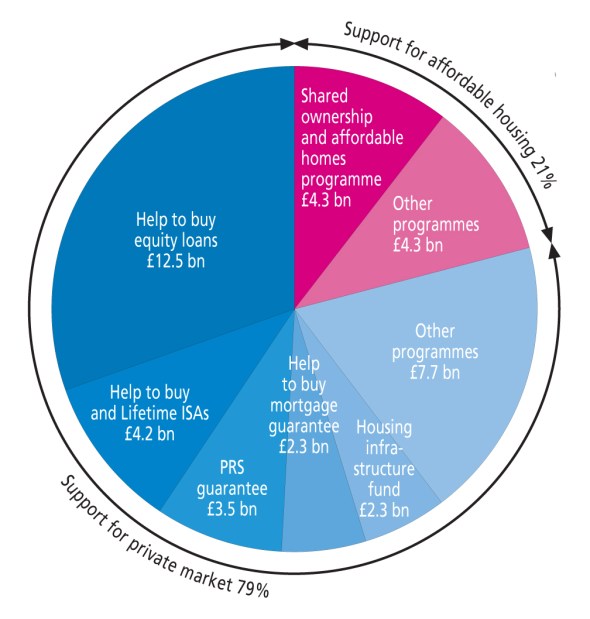
These are revised figures that take account of the extra money for affordable housing announced by chancellor Philip Hammond last November. Even after that, even after adjustments for lower than expected spending on mortgage guarantees, and even including the Right to Buy pilot in the pink part of the graph, we are still spending £4 on support for the private market for every £1 we spend on support for affordable housing.
What really leapt off the page at me in this chart was that the government is set to spend £4.2 bn on Help to Buy and Lifetime Individual Savings Accounts (ISAs) over the same period as it spends £4.3 bn on the main Shared Ownership and Affordable Homes programme.
Read the rest of this entry »
Posted: September 11, 2017 | Author: julesbirch | Filed under: History, Right to buy, Social housing |
Originally posted as a column for Inside Housing on September 11.
In case you missed it, you still have chance to catch up with a superb history of social housing that ran over the last two weeks on Radio 4.
Lynsey Hanley’s Streets Apart told the story from the beginning of council housing in the 19th Century in Liverpool to the present. I got the impression that most of it was made before the fire at Grenfell Tower, but its shadow looms over everything.
Why is the series so good? Partly that Lynsey Hanley knows what she is talking about (as author of Estates: An Intimate History and Respectable: The Experience of Class). She is also an engaging presenter with an accent not normally heard on Radio 4 that comes from her upbringing on the Chelmsley Wood estate in Solihull.
Partly because her interviewees know what they are talking about: they are a mixture of experts in local areas, in architecture, planning and housing and local residents who are given time to tell their stories.

But also because she recognises the nuances and contradictions in the history of social housing and in its present: Michael Heseltine comes out of it surprisingly well for the minister who introduced the Right to Buy; another Tory minister Harold Macmillan gets the last word; and the final episode features more than one side to current regeneration controversies.
Her message may be obvious in one sense and, as she says, naïve and utopian in another: in the wake of Grenfell Tower, housing needs the same national priority as health and education.
But the thesis behind it is also a challenge to those of us who would agree with all of that: ‘Social housing in Britain has suffered from the flaw of being regarded as being only for poor and working class people and not for everyone.’
Read the rest of this entry »
Posted: August 17, 2017 | Author: julesbirch | Filed under: Home ownership, Private renting, Social housing |
Originally published as a column for Inside Housing on August 17.
Beneath the immediate crisis about a lack of new homes lies a long-running one about the homes that we have already built.
It’s hard to look much beyond the stat in a report published on Friday by the Local Government Association (LGA) that new homes built today will have to last 2,000 years at current rates of demolition and replacement.
Unless the output of the likes of Barratt and Taylor Wimpey is really going to stand for as long as some of the glories of Ancient Rome, something clearly does not add up. This graph shows the age of the stock broken down by tenure:

The report by Residential Analysts finds that large numbers of homes across all tenures are not of appropriate quality, with the private rented sector representing the biggest cause for concern, with problems such as damp and poor energy efficiency concentrated in the oldest stock.
The number of homes failing to meet the Decent Homes standard has been improving in recent years total cost of bringing them up to scratch is still estimated at £27 billion, of which just £2 billlion is for social housing.
Read the rest of this entry »
Posted: August 10, 2017 | Author: julesbirch | Filed under: Regeneration, Social housing | Tags: Dispossession |
Originally posted as a column for Inside Housing on August 10.
Dispossession: The Great Social Housing Swindle is an important film that arrives at an even more important moment for social housing.
Even before the Grenfell Tower fire it would have posed vital questions about the speed at which we are running down the stock of social rented homes. In the wake of that awful night in June they have become existential ones about the way we house our poorest communities.
The documentary by Paul Sng tells the story of what’s happened to social housing since the introduction of the Right to Buy turned expansion into decline in the late 20th century and especially since regeneration of existing estates became a contentious issue in the early 21st century.
I finally caught up with it this week but there are plenty more screenings in cinemas and other venues around Britain over the next few months.
Narrated by Maxine Peake, it’s a story that will not be new to people who know housing but may well be to a more general audience
It’s about how we got from the Bevan and Macmillan building booms via the Thatcher property owning democracy and Tony Blair’s ‘no forgotten people’ speech on the Aylesbury estate to the demolition and diaspora of the Heygate.
Read the rest of this entry »
Posted: July 19, 2017 | Author: julesbirch | Filed under: Social housing | Tags: English Housing Survey |
Originally published as a column for Inside Housing on July 19
Results from the English Housing Survey last week provide a detailed snapshot of who lives where and in what sort of conditions and how they feel about it.
The picture that emerges of social renting is not exactly a new one but it also confounds many of the stereotypes about the sector and the people who live in it.
Here is a baker’s dozen of the highlights that I picked out from the survey showing the state of the sector in 2015/16:
1) The overall picture: The social rented sector was home to 3.9m households in England – 2.3m with housing associations as their landlord and 1.6m with local authorities.
That total has stayed broadly the same for the last three years but the English Housing Survey does not separately identify a rising number of affordable rent properties (an estimated 123,000 by April 2015).
As home to 17% of households, social renting is now comfortably behind private renting (20%).
Read the rest of this entry »
Posted: July 11, 2017 | Author: julesbirch | Filed under: Help to Buy, Housing benefit, LHA cap, Right to buy, Social housing, Supported housing |
Originally published on July 11 as a column for Inside Housing.
If we need to ‘invest in good work’ what about good homes?
Theresa May was speaking at the launch of the Taylor review of the gig economy on Tuesday exactly a year after she became prime minister.
In the wake of her failed election gamble, she needs non-Tory support to address the challenges identified in the report.
And her plea to the other parties to ‘come forward with your own views and ideas about how we can tackle these challenges as a country’ is being interpreted as being about more than just the labour market.
So if the challenge of precarious work requires cross-party co-operation what about that of precarious housing?
Read the rest of this entry »
Posted: June 21, 2017 | Author: julesbirch | Filed under: Homelessness, Private renting, Social housing | Tags: Grenfell Tower |
Originally published as a column for Inside Housing on June 21.
A scaled down Queen’s Speech with a dressed down monarch still left some room for housing but this is a humbled government with limited ambitions.
Left rudderless by the loss of its majority and the departure of key personnel from Downing Street, this is a legislative programme dominated by Brexit but with the dark shadow of Grenfell Tower looming over it.
There is room for a Draft Bill to end letting agent fees to private tenants and lots of warm words about the Housing White Paper but this is a very different Queen’s Speech to the one that seemed likely before the night of June 8 and the events of June 14.
Read the rest of this entry »

