The state of the housing nation 2023
Posted: December 18, 2023 Filed under: Bedroom tax, Energy efficiency, Private renting, Tenants, Tenure change | Tags: English Housing Survey Leave a commentAs 2023 draws to a close, what is the state of the housing nation?
As always, the best place to start is the English Housing Survey, which has just published headline results for 2022/23. Here are five things that caught my attention.
1 The tenure and wealth gap
The results of the survey need to be treated with more caution than usual when comparing the results this year thanks to the impact of the pandemic, but the general trend on housing tenure is pretty clear.
Thanks in part to Help to Buy and other government schemes, the proportion of households who own their own home (64 per cent) has stabilised while the relentless growth of the private rented sector (18 per cent) has slowed. The social housing sector is still in slow decline but there is a significant difference between London (where it is home to 21 per cent of households) and England as a whole (16 per cent).
There were 874,000 recent first-time buyers in 2022/23 and they had an average (mean) deposit of just over £50,000.
Given that, it’s not surprising that family wealth has become increasingly important to people’s chances of buying. A growing proportion received help from family or friends (36 per cent, up from 27% in 2021/22 and 22 per cent in 2003/04) while 9 per cent used an inheritance for a deposit.
They were also higher earners: the majority of successful first-time buyers (58 per cent) came from the top two income quintiles and only a small minority (16 per cent) came from the bottom two.

One small step (backwards)
Posted: January 25, 2018 Filed under: Homelessness, Private renting, Tenure change Leave a commentOriginally posted on my blog for Inside Housing on January 25.
More of us now rent from a private landlord than at any time since the first man walked on the moon.
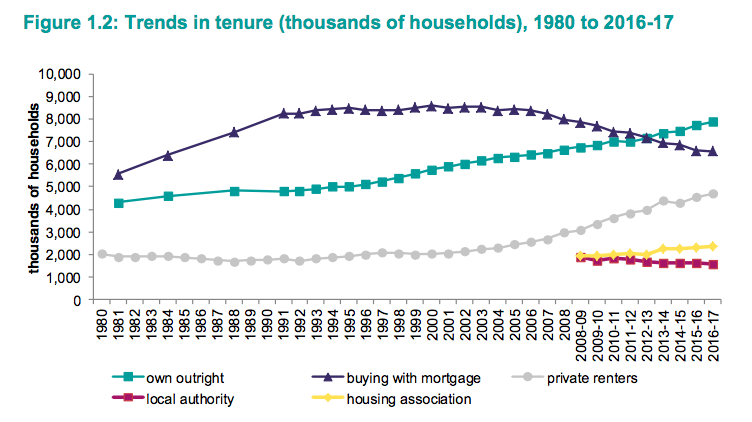
Figures in the 2016/17 English Housing Survey published on Thursday show yet another rise in the proportion of households renting from a private landlord and decline in home ownership.
More than 20% of us are now private renters, the highest figure in any year since 1969, the year of Woodstock and one small step for man.
Owner-occupation declined slightly from 62.9% to 62.6% but that overall figure conceals two very different trends.
The proportion of households who own outright rose again to 34.1% while the proportion buying with a mortgage fell to just 28.4%.
To put that second figure in perspective, throughout the 1990s more than 40% of us were buying with a mortgage.
Social renting remained stable at just over 17% of households, but with the local authority share of that falling again.
Home ownership: Decline and rise?
Posted: February 18, 2016 Filed under: Home ownership, Private renting, Social housing, Tenure change | Tags: Brandon Lewis, English Housing Survey Leave a commentOriginally posted on February 18 on Inside Edge 2, my blog for Inside Housing
At first sight, headline results from the English Housing Survey published on Thursday are very good news for Brandon Lewis.
As the housing minister was quick to point out, the survey shows 2014/15 was the first year since 2003 when the home ownership rate in England did not fall. And, as this graph also shows, private renting fell for the first time since 1999:

He might also have pointed to this graph showing a surprise turnaround in the tenure prospects of Generation Rent:

The fall in ownership over the last 10 years has been most marked among young people, so this increase in ownership among the 25-34s in 2014/15 and decline in private renting is a marked reversal of that trend.
On the face of it then it’s good news for ministers in their quest to revive the property-owning democracy and bad news for doom-mongers (like me). Perhaps all those dire predictions that we are on course to become a nation of private renters are wrong? Maybe Help to Buy really is working? Did Labour commission the Redfern Review into the decline of home ownership to look at a problem that no longer exists?
 Jules Birch