Rough sleeping initiative deja vu
Posted: April 3, 2018 Filed under: Rough sleeping | Tags: Homelessness Reduction Act Leave a commentOriginally posted on April 3 on my blog for Inside Housing.
If the new initiative to reduce rough sleeping sounds vaguely familiar it’s because we have been here before.
The package of measures announced by Sajid Javid over Easter includes a new Rough Sleeping Team made up of external experts, a £30 million fund for 2018/19 with further funding for 2019/20 targeted at areas with high numbers of rough sleepers and £100,000 of funding to support frontline workers across the country.
It’s a welcome news just as the Homelessness Reduction Act is about to come into force, and it comes on top of existing investment in homelessness programmes, piloting of Housing First and closer collaborative working inside and outside government.
But it also made me think back to the last time a Conservative government faced a rough sleeping crisis and announced a Rough Sleepers Initiative (RSI).
In 1990 the number of people sleeping rough in central London soared in the wake of a recession and benefit cuts that hit 16- and 17-year-olds in particular.
Then as now, ministers denied that benefit cuts were to blame. Then as now, the sight of people sleeping in doorways and makeshift camps got national media and political attention.
April arrives with some rare good news
Posted: March 29, 2018 Filed under: Help to Buy, Homelessness, Housing benefit, Local housing allowance, Mortgages, Private renting, Uncategorized, Universal credit Leave a commentOriginally published on March 29 on my blog for Inside Housing.
Sometimes it feels like I’ve written a blog at this time every year with the headline ‘April is the cruellest month’.
It’s not that I have a TS Eliot fixation nor (I hope) that I endlessly repeat myself but because ever since 2010 the start of the financial year seems to have meant yet another benefit cut or housing policy change to cope with.
This year is a bit different not so much because there is no bad news but because there is some good news as well. Here are some examples:
- The u-turn on the withdrawal of support for housing costs for 18-21 year olds under universal credit announced on Thursday. This was a cumbersome policy that required significant exemptions and barely saved any money but it’s still a significant change to the original pledge to make young people ‘earn or learn’.
- The Homelessness Reduction Act passed in 2017 applies from April 3. The legislation should be a big step forward in ensuring that more people get help earlier but despite a recent announcement on funding there are still well-founded concerns about whether councils have the money to implement it.
- Claimants already getting housing benefit who move on to universal credit will from April be paid an additional two weeks of housing benefit. That may not be much consolation for the (in theory) five-week wait for their first universal credit but the payment (worth an average of £233) should ease the transition a bit –and it is not recoverable.
- It will be unlawful for landlords to give new tenancies on the least energy efficient property from April 1 – all rented property will have to qualify for at least an Energy Performance Certificate rating of E so (in theory) tenants will no longer be stuck paying high heating bills for the worst F and G property.
- More measures introduced against rogue landlords in the Housing and Planning Act 2016 come into force, including powers for councils to issue banning orders against the worst offenders and implementation of a database of landlords and letting agents convicted of some offences.
Bear in mind too that it’s not so long ago that I would have been writing about plans to apply a Local Housing Allowance (LHA) cap to social and supported housing from…April 2018.
For all that good news, though, the suspicion remains that it will at best mitigate the impact of policies already implemented and still in the pipeline.
One small step (backwards)
Posted: January 25, 2018 Filed under: Homelessness, Private renting, Tenure change Leave a commentOriginally posted on my blog for Inside Housing on January 25.
More of us now rent from a private landlord than at any time since the first man walked on the moon.
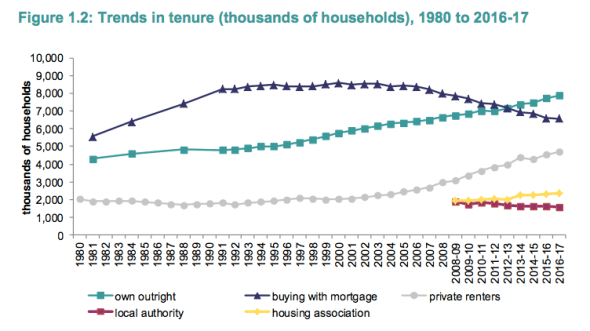
Figures in the 2016/17 English Housing Survey published on Thursday show yet another rise in the proportion of households renting from a private landlord and decline in home ownership.
More than 20% of us are now private renters, the highest figure in any year since 1969, the year of Woodstock and one small step for man.
Owner-occupation declined slightly from 62.9% to 62.6% but that overall figure conceals two very different trends.
The proportion of households who own outright rose again to 34.1% while the proportion buying with a mortgage fell to just 28.4%.
To put that second figure in perspective, throughout the 1990s more than 40% of us were buying with a mortgage.
Social renting remained stable at just over 17% of households, but with the local authority share of that falling again.
New name, new ministers, new start?
Posted: January 23, 2018 Filed under: Council housing, Grenfell Tower, Homelessness, Land | Tags: Dominic Raab, MHCLG Leave a commentOriginally posted on my blog for Inside Housing on January 23.
It’s got a new name and new ministers but how much has really changed at the Ministry for Housing, Communities and Local Government?
Yesterday’s MCHLG questions marked the first time that Sajid Javid and his new team have faced MPs since the reshuffle earlier this month.
Judging from the secretary of state’s first few responses, the answer seemed to be not much.
His exchanges with his Labour shadow John Healey over the painfully slow progress on replacing unsafe tower block cladding have already been widely reported.
On the latest figures, 312 buildings have been tested and 299 have been failed but cladding has been taken down and replaced on just three.
‘How has it come to this?’ asked Healey. ‘Seven months on from Grenfell, only one in four families who are Grenfell survivors has a new permanent home. The Government still cannot confirm how many other tower blocks across the country are unsafe. Ministers still refuse to help to fund essential fire safety work when they know that blocks are dangerous.’
10 things about 2017: part one
Posted: December 22, 2017 Filed under: Grenfell Tower, Homelessness, Housebuilding, Housing benefit, LHA cap, Temporary accommodation Leave a commentOriginally posted as a column for Inside Housing on December 22.
As in 2016, it seemed like nothing would ever be the same again after a momentous event halfway through the year.
The horrific Grenfell Tower fire on June 14 means that the headline on this column should really have read ‘nine other things about 2017’. Just as the Brexit voted has changed everything in politics, so it is almost impossible to see anything in housing except through the prism of that awful night.
That said, 2017 was another year of momentous change for housing, one that brought a few signs of hope too. Here’s the first of my two-part review of what I was writing about.
The horrors of temporary housing
Posted: November 8, 2017 Filed under: London, Temporary accommodation 3 CommentsOriginally posted as a column for Inside Housing on November 8.
From ‘temporary’ homes that last for 19 years to families with young children living in the middle of an industrial estate, a Commons debate on Tuesday found MPs queuing up to relate horror stories from their constituencies.
Labour MP Siobhan McDonagh opened the debate about temporary accommodation with an eloquent and angry explanation of the situation facing 78,000 families and 120,000 children but she was joined by MPs from all parties in calling for urgent changes.
The stats about temporary accommodation are grimly familiar. Among them are a 66% increase in the number of children affected since 2010, 1,200 families with children housed in B&Bs beyond the six-week legal limit and a five-fold increase in families from London housed outside the capital since 2012.
All this has come at a cost of £3.5 bn over the last five years for accommodation that is stretching the definition of ‘temporary’ to breaking point.
Siobhan McDonagh said three quarters of families in temporary accommodation in London have been there for more than six months and one in 10 for more than five years. There are even cases in Camden and Harrow of families living in ‘temporary’ accommodation for 19 years.
A graphic illustration of that came from David Lammy, Labour MP for Tottenham, later in the debate:
‘One family in my constituency have been living in temporary accommodation for 14 years. Another family have been there for 17 years. That family have seen their children grow up in temporary accommodation—the only home that the children have ever known, from their first day at primary school to their first day at secondary school. Next year, the 18th birthday of the eldest child will be celebrated in this so-called temporary accommodation.’
Crisis warns of surge in homelessness
Posted: August 10, 2017 Filed under: Homelessness, Poverty, Prevention, Welfare reform | Tags: Crisis Leave a commentOriginally posted as a column for Inside Housing on August 10.
If the true scale of homelessness revealed in a report for Crisis is shocking enough now, try looking at the projections for the future.
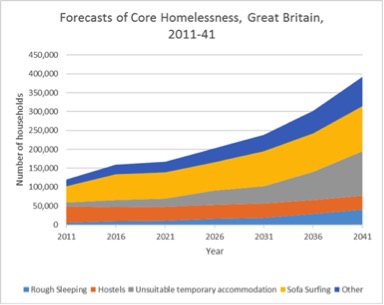
The report by Professor Glen Bramley of Heriot Watt University estimates that what it calls ‘core homelessness’ affected 160,000 households in 2016, an increase of a third since 2011.
That means that at any one time:
- 9,100 people were sleeping rough
- 68,300 households were sofa surfing
- 19,300 households were living in unsuitable temporary accommodation
- 37,200 households were living in hostels
- 26,000 households were living in other circumstances, including:
-
- 8,900 households sleeping in tents, cars or on public transport
- 12,100 households living in squats
- 5,000 households in women’s refuges or winter night shelters.
The report estimates that these include 57,000 families including 82,000 adults and 50,000 children, so that the total core homeless population is 236,000.
However, the total is forecast to rise by 76% in the next decade. After a steady rise to 167,000 households by 2021 the total is expected to accelerate over the to 238,000 by 2031 and 392,000 by 2041.
As the graph shows, the increases are expected to be especially sharp in unsuitable temporary accommodation, which includes bed and breakfast accommodation and out of area placements.
The day Mrs Thatcher came for tea
Posted: August 3, 2017 Filed under: London, Right to buy, Temporary accommodation | Tags: Dispossession, Havering 2 CommentsOriginally published as a column for Inside Housing on August 3.
If the Right to Buy has a birthplace it’s a terraced house at 39 Amersham Road in Harold Hill, near Romford in Essex.
True, the sale was the 12,000th rather than the first and 11 August, 1980 was not the actual birth date of the policy either.
However, both have come to symbolise the Right to Buy because this was the place and that was the day that Margaret Thatcher came for tea.
The former prime minister joined the Patterson family, who had bought their home for £8,315 after 18 years as tenants of the Greater London Council (GLC).
Two things came together to remind me of that photo opportunity this week: first, archive footage used in the film Dispossession (full review to follow soon); and second a good investigation by the local paper of hidden homelessness in the area.

