Will Letwin be worth the wait?
Posted: March 13, 2018 Filed under: Affordable housing, Housebuilding, Land | Tags: Letwin review Leave a commentOriginally published on March 13 on my blog for Inside Housing.
So, with unintentional irony, the inquiry into why it takes so long to get new homes built is itself taking longer than expected.
For all the advance speculation and ministerial statements in the last few days, the Letwin Review of build-out rates was not published alongside today’s Spring Statement.
Instead the former Conservative Cabinet minister published a four-page letter offering housing secretary Sajid Javid an interim update on the work of the inquiry focusing on what is happening on large sites operated by large housebuilders.
A ‘draft analysis’ will follow by the end of June offering a description of the problem and its causes but final recommendations will only be made in time for the Budget in November.
In truth, expectations that Letwin would be able to offer instant solutions within a few months were always likely to be dashed – not that this stopped ministers from pre-empting it with warnings to housebuilders to ‘do their duty’ in the planning announcements last week.
Perhaps significantly, the draft update has only one mention of the supposedly crucial issue of ‘land banks’, the nefarious practice by which housebuilders allegedly hoard land with planning permission until they can make the most money.
However, Letwin rejects most of their usual excuses too – everything from shortages of labour, materials and capital to problems with transport infrastructure, utility connections and constrained logistics on site.
He argues instead that the ‘fundamental driver of build out rates once detailed planning permission is granted for large sites appears to be the “absorption rate”.’
This is ‘the rate at which newly constructed homes can be sold into (or are believed to be sold successfully into) the local market without materially disturbing the market price’.
Steps in the right direction that don’t go far enough
Posted: March 5, 2018 Filed under: Home ownership, Housebuilding, Planning 1 CommentOriginally published on my blog for Inside Housing on March 5.
Theresa May is a politician with a gift for saying the right things but somehow in the wrong way.
I’m thinking here not just of the obvious examples such as the ‘nothing had changed during the election campaign’ and the collapsing lettering of ‘Building a Britain that Works for Everyone’ during her Conservative conference speech last year. She does it even when she is most in control of what she is saying.
She did it in her first speech as prime minister when she dedicated herself to tackling ‘burning injustices’ but only succeeded in drawing attention to the fact they were the legacy of the previous six years of Conservative rule.
She did it on Friday when her big speech on Brexit rightly pointed out that ‘we can’t have everything’ only to prompt a German journalist to ask ‘is it all worth it?’.
And she did it again in her speech on Monday launching the new version of the National Planning Policy Framework.
Return of the housing ministry
Posted: January 9, 2018 Filed under: Civil service, Housebuilding | Tags: Alok Sharma, Reshuffle, Said Javid Leave a commentOriginally published as a column for Inside Housing on January 10.
What’s in a name? Only time will tell how important the change of departmental moniker will be but it was surely the minimum that Theresa May needed to do to show that housing now ranks as a top priority for her government.
The man in charge may still be the same (Sajid Javid) but both the creation of the Ministry for Housing, Communities and Local Government (MHCLG) and the order of the words in the title are significant.
By my reckoning this is the first time since 1970 that the word ‘housing’ has appeared in the title of the organisation and the secretary of state responsible for it.
In the 38 years since the Ministry of Housing and Local Government was abolished to create the Department of the Environment the name has been changed again and again to reflect different briefs and priorities.
Between Peter Walker back in 1970 and Sajid Javid in 2018 we’ve had 28 different housing ministers of middle and junior rank, a handful of them with the right to attend Cabinet but not vote in it.
10 things about 2017: part one
Posted: December 22, 2017 Filed under: Grenfell Tower, Homelessness, Housebuilding, Housing benefit, LHA cap, Temporary accommodation Leave a commentOriginally posted as a column for Inside Housing on December 22.
As in 2016, it seemed like nothing would ever be the same again after a momentous event halfway through the year.
The horrific Grenfell Tower fire on June 14 means that the headline on this column should really have read ‘nine other things about 2017’. Just as the Brexit voted has changed everything in politics, so it is almost impossible to see anything in housing except through the prism of that awful night.
That said, 2017 was another year of momentous change for housing, one that brought a few signs of hope too. Here’s the first of my two-part review of what I was writing about.
What a way to run a housing system
Posted: September 14, 2017 Filed under: Help to Buy, Housebuilding, Social housing | Tags: UK Housing Review Leave a commentOriginally posted on September 14 as a column for Inside Housing.
The balance of funding between government funding for home ownership and affordable housing schemes continues to astonish even after the change in emphasis under Theresa May.
Revised figures prepared for Thursday’s publication of the UK Housing Review Briefing Paper show that total support for the private market up to 2020/21 is set to total £32 bn compared to support for affordable housing investment of just £8.6 bn.
This pie chart really brings it home:
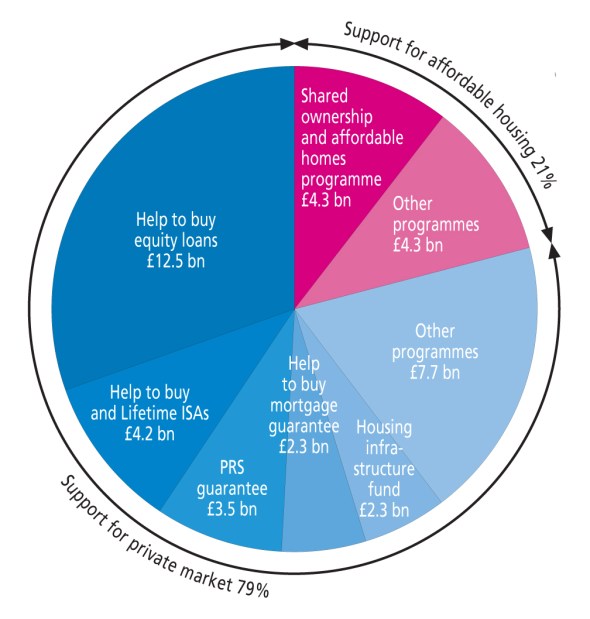
These are revised figures that take account of the extra money for affordable housing announced by chancellor Philip Hammond last November. Even after that, even after adjustments for lower than expected spending on mortgage guarantees, and even including the Right to Buy pilot in the pink part of the graph, we are still spending £4 on support for the private market for every £1 we spend on support for affordable housing.
What really leapt off the page at me in this chart was that the government is set to spend £4.2 bn on Help to Buy and Lifetime Individual Savings Accounts (ISAs) over the same period as it spends £4.3 bn on the main Shared Ownership and Affordable Homes programme.
Simple ‘solutions’ plague our thinking about housing
Posted: August 29, 2017 Filed under: Home ownership, Housebuilding, Planning | Tags: Analysis Leave a commentOriginally published as a column for Inside Housing on August 29.
‘What makes the housing crisis so maddening is that there is a simple solution: Britain needs to get building.’
So ran a tweet a couple of weeks ago from The Economist about an article on How to Solve Britain’s Crisis. Unleash the market, build on the green belt and, hey presto, the housing crisis is over.
In fairness, the article’s proposition was a bit more complicated than the tweet implied – it also proposed reform of stamp duty and council tax – but it is still an illustration of the way that ‘simple solutions’ plague our thinking about housing.
What I mean by that is that there may well be good arguments that can be made for building on the green belt, or rent control, or building a million council houses, or prefabrication or any of the other quick fixes that are routinely trotted out.
It’s certainly hard to see a solution that does not involve more homes, better conditions for private renters, a greater role for local authorities and innovations in construction.
However, it’s quite different when one of them is proposed as the solution. Usually this is by one of the ‘unleash the market’ brigade who believe that the housing crisis is all down to planning.
Housing in the Conservative manifesto
Posted: May 18, 2017 Filed under: Compulsory purchase, Council housing, Homelessness, Housebuilding, Housing First | Tags: Conservatives 1 CommentOriginally posted on May 18 on my blog for Inside Housing.
This is a Conservative manifesto with only two firm targets on housing but lots of interesting hints about future direction and some intriguing omissions.
The first target is to halve rough sleeping by 2022 and eliminate it completely by 2027 by implementing the Homelessness Reduction Act and piloting a Housing First approach.
The 2022 target may seem bold but it would mean that rough sleeping would still be significantly higher than it was in 2010 when the coalition came to power.
The one for 2027 is incredibly ambitious and would mean matching Finland’s incredible record on homelessness within ten years.
Sajid Javid obviously returned fired up from his visit to Helsinki but you wonder if he took on board just how comprehensive and well-funded the Finnish version of Housing First needed to be to work.
The second target is ‘meet our 2015 commitment to deliver a million homes by the end of 2020 and we will deliver half a million more by the end of 2022’.
The first bit is unambitious and should be achievable, especially as the end point has been shifted from May 2020 (the original end of the parliament) to December 2020.
As the National Audit Office pointed out in January, that would actually mean that fewer new homes will be built over the next three years than were achieved last year. This is on the basis of the net additional supply of homes rather than just housebuilding completions.
The second bit is a different matter. A quick look at the net supply figures shows that there have only been three years in the last 25 when we have exceeded 200,000.
 Jules Birch