Worst fears
Posted: February 19, 2013 Filed under: Wales, Welfare reform Leave a commentSo the government has finally admitted the potentially devastating consequences of welfare reform in a cumulative impact assessment.
Before anyone starts to think that Iain Duncan Smith has undergone a dramatic change of heart, I should add that I am of course taking about the Welsh government, not the UK one.
The second stage review of the impact of welfare reform in Wales is accompanied by an analysis by the Institute for Fiscal Studies (IFS) of the effects of welfare reform on labour supply in Wales.
Read the rest of this post on Inside Edge, my blog for Inside Housing
One-way street
Posted: February 14, 2013 Filed under: Housing market, Mortgages, Private renting Leave a commentRepossessions are at their lowest and loans to first-time buyers are at their highest since 2007. Has the housing market finally turned the corner?
That’s certainly one interpretation of stats released by the Council of Mortgage Lenders (CML) this week showing big improvements since the year the credit crunch hit.
On Tuesday it revealed that 216,200 first-time buyers became homeowners in 2012. That was a 12 per cent rise on 2011 and it’s the first time since 2007 that the annual total has exceeded 200,000.
Read the rest of this post on Inside Edge, my blog for Inside Housing
Capital crisis
Posted: February 13, 2013 Filed under: Affordable housing, Homelessness, Housing market Leave a commentThe scale of the housing crisis facing London is hitting home with both Londoners and their political leaders.
In an opinion poll in the Evening Standard published today, half of people in the city say they fear being driven out of their neighbourhood by the cost of housing and six out of ten say there is a crisis in their area.
At one end of the housing scale, soaring demand from global investors is threatening to push house prices even further out of reach of ordinary Londoners. According to a report yesterday from the Home Builders Federation, it now takes the average first-time buyer 24 years to raise a deposit in London.
Read the rest of this post on Inside Edge, my blog for Inside Housing
Accounting for the new self-employed
Posted: February 6, 2013 Filed under: Labour market 2 CommentsA report out today from the ONS confirms the big increase in self-employment in the UK seen since the start of the Global Financial Crisis.
As a result of the recessions that triggered, the number of employees fell by 434,000 between 2008 and 2012. In complete contrast, the number of self-employed people rose by 367,000 over the same period, with 219,000 of that coming between 2011 and 2012.
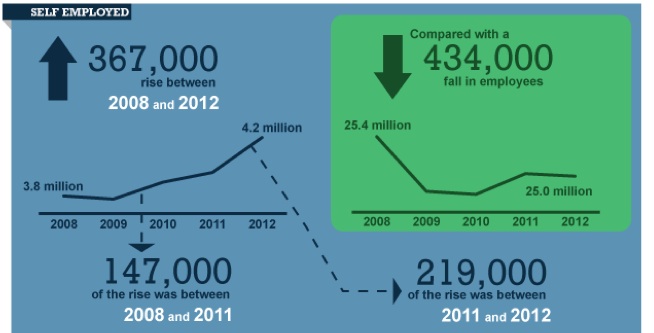
Source: ONS
These are remarkable figures, especially when you consider, as the FT data blog points out, that self-employment has actually fallen in most other countries in the OECD.
Growing pains
Posted: February 5, 2013 Filed under: Local government, Private renting Leave a commentIf you drive a car, you need a license, an MOT and insurance. Why should it be any different to rent out a house?
That point – made by Jacky Peacock of the National Private Tenants Organisation at a Communities and Local Government committee hearing yesterday – got me thinking about the whole issue of licensing and the private rented sector.
Read the rest of this post on Inside Edge, my blog for Inside Housing
Changing the culture
Posted: January 31, 2013 Filed under: Private renting Leave a commentAs a new report from Shelter shows that private rents continue to rise, politicians are starting to accept the need for reform.
The charity published figures this morning showing that rents rose by an average of 2.8 per cent in the last 12 months. That’s faster than the 1.7 per cent increase in house prices in 2012 revealed by the Land Registry this week and comes at a time when wages are at a standstill.
Read the rest of this post on Inside Edge, my blog for Inside Housing
The state of self-employment
Posted: January 30, 2013 Filed under: Labour market, Welfare reform Leave a commentThe conjunction of the deadline for self-assessment tax returns and the start of my 21st year as a freelance has got me thinking about self-employment.
Like most people I’ve found there are good and bad sides to working (at least in theory) for yourself. The feeling of not being tied to one particular employer and of (at least in theory) being free to do anything you want are both potentially liberating. Not being dependent on one organisation for your living should mean you’re better off than its employees in a downturn (at least in theory). You can offset your (legitimate, please note, HMRC) expenses against income and if you are more high-powered than me you can even found your own personal service company and employ yourself. A combination of self-employment and technology has enabled me to live and work in a part of the country where reasonably paid full-time jobs are a rarity.
On the downside, if you work mainly at home self-employment can leave you isolated from the sort of workplace life that everyone takes for granted. If you work mainly inside workplaces a thick skin is sometimes required when you have to watch complete idiots take charge (in my case thankfully not for several years, I hasten to add!). If you’re doing well, your leisure time can get squeezed. If you’re doing badly, it will be spent worrying that someone will pay you on time to pay the bills. You have few legal rights, though I’ve only been let down badly a couple of times and the rights of employees are steadily disappearing too. Your debts may well be higher than those of an employee. And if, say, a government comes along determined to cut public spending in the middle of a recession you can find sources of income rapidly drying up because the freelancers are the easiest people to cut. Thanks, George!
But enough about me: what about the state of self-employment as a whole?

