April is the cruellest month
Posted: November 5, 2012 Filed under: Homelessness, Housing benefit, Welfare reform | Tags: council tax benefit, welfare changes Leave a commentEvery time you think you have got your head around the impact of the April 2013 welfare changes you realise you have forgotten something that makes it even worse.
I don’t need reminding that there are now just 147 days until the bedroom tax and overall benefit cap take affect. I know that increases in the local housing allowance will be restricted to CPI inflation from the same date. I realise that a range of other cuts in benefits and the localisation of council tax benefit and the social fund with reduced funding come in at the same time.
Supply and demand
Posted: November 1, 2012 Filed under: Affordable housing, Housebuilding, Housing benefit, Private renting Leave a commentThere is good news, bad news and really bad news in figures out today on housing supply in England.
The good news first: net additional housing supply rose 11 per cent in 2011/12 to 134,900 in 2011. That follows three consecutive annual falls in the wake of the credit crunch and represents a return to the level seen in the early 2000s. Net additional supply is the government’s preferred measure since it includes not just new build homes but gains and losses from demolitions and conversions of buildings from one use to another too.
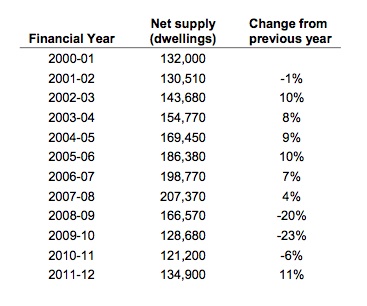
Net additional housing supply in England (source: DCLG)
Red flags
Posted: October 30, 2012 Filed under: Housing benefit, Poverty, Welfare reform Leave a commentAs the slow motion train crash of welfare reform continues, the driver is ignoring a succession of people desperately waving as he passes them.
Heedless of the big red flags they are holding, Iain Duncan Smith and his conductor Lord Freud sometimes even wave back and blow the whistle of their sleekly designed train in acknowledgement of what they see as the congratulations of the crowd.
Read the rest of this post on Inside Edge, my blog for Inside Housing
Barbed wire
Posted: October 25, 2012 Filed under: Housing market, Mortgages Leave a commentIs it possible to ‘hard-wire common sense’ into a mortgage market that has a track record of irrational excess?
The Financial Services Authority (FSA) launched the final version of its Mortgage Market Review (MMR) this morning after a marathon round of consultation with lenders and consumer groups.
Read the rest of this post at Inside Edge, my blog for Inside Housing
Revealing the real Rachman?
Posted: October 24, 2012 Filed under: History, Private renting | Tags: Landlords, Rachman 3 CommentsIt’s almost 50 years since Peter Rachman died and we still use Rachmanism as a shorthand term for everything that is bad about bad landlords. But is what we think we know wrong?
That is the premise of a fascinating documentary on BBC Radio 4 this week that set out to find The Real Rachman – the Lord of the Slums (listen again on iplayer here). The legend it investigated was of the evil vice racketeer who owned slum properties in Notting Hill packed full of tenants with working girls ‘bending the basement’ below them. In 1963 the People exposed an ‘empire based on vice and drugs, violence and blackmail, extortion and slum landlordism the like of which this country has never seen and let us hope never will again’. The same year Panorama exposed a ‘big time 20th century racketeer’ who sent men round with dogs to evict his tenants.
Home truths
Posted: October 22, 2012 Filed under: Affordable housing, Housebuilding, Private renting Leave a comment‘We’re not in any way complacent,’ Mark Prisk told the Today programme this morning – having spent his interview being just that.
It’s the first time I’ve caught a media appearance by the successor to Grant Shapps, who was so ever-present in the radio and TV studios that he was dubbed the minister for Daybreak. Prisk is not on twitter either so other than a few brief interviews and a few blogs he is still a bit of a mystery to me.
Read the rest of this post at Inside Edge, my blog for Inside Housing
Joining the dots on unemployment and welfare reform
Posted: October 21, 2012 Filed under: Labour market, Welfare reform | Tags: economy Leave a commentThere’s a contradiction lurking behind the good news about falling unemployment: we seem to be succeeding in getting people back into work who don’t want to be and failing with people who do.
The headline numbers in the labour market statistics are that unemployment fell by 50,000 in the three months to August to 2.5 million and the number of people in employment rose by 212,000 to 29.6 million. The latter figure is up by 462,000 since the 2010 election and is the highest total since records began in 1971.
Part of the reason why the number of people in work rose faster than unemployment fell is that the proportion of people between 16 and 64 defined as economically inactive is also falling. The total is down by 243,000 since the election to just over nine million and more than half of that fall (138,000) happened in the last three months.
Rent spiral
Posted: October 19, 2012 Filed under: Housing benefit, Private renting Leave a commentRemember when David Cameron claimed that housing benefit cuts were bringing down rent levels? I bet he doesn’t now either.
Cameron said at prime minister’s questions in January that: ‘What we have seen so far, as housing benefit has been reformed and reduced, is that rent levels have come down, so we have stopped ripping off the taxpayer.’
Read the rest of the rest of this post on Inside Edge, my blog for Inside Housing.
Hidden costs
Posted: October 15, 2012 Filed under: Affordable housing Leave a commentBit by bit the facts about the affordable rent programme are leaking out but far too much remains hidden or unclear.
On Friday, in the typically under-stated style of all-party committees, MPs published their verdict so far. The public accounts committee concludes that ‘it is not yet clear whether the programme will deliver value for money in the long term’ and that ‘the department needs to do more work to understand the impact of the programme on tenants and its interaction with wider welfare reforms’.
Read the rest of this post on Inside Edge, my blog for Inside Housing

