Where the money really goes in housing
Posted: March 21, 2018 Filed under: Affordable housing, Help to Buy, Home ownership, Housing benefit, Private renting, Social housing | Tags: UK Housing Review Leave a commentThree comparisons leap out from the latest edition of the indispensable UK Housing Review published on Wednesday.
The first two are not new in themselves and the third is only a crude estimate but all three need repeating again and again for a real appreciation of where spending on housing goes and exactly who is subsidising who.
First comes the main one highlighted by the Chartered Institute of Housing (CIH): the shift from bricks and mortar to personal subsidies, or from grants for new homes and repairs to old ones to housing benefit.
This series of pie charts from the Review shows the change over the last 40 years and the total amount of housing subsidies in real terms:

Note first that supply subsidies have sunk to just 4.3 per cent of the total pie – this despite all the cuts in housing benefit seen since 2010 and the fact that the figures to not include continuing tax reliefs for home owners (see below for more on that).
Second, note that this does not save money. Total subsidies are now 48 per cent higher in real terms than at the turn of the century (when admittedly social housing investment was very low) but they are also approaching the levels of 30 years ago (when investment was significantly higher and the unemployment rate was three times what it is now).
One small step (backwards)
Posted: January 25, 2018 Filed under: Homelessness, Private renting, Tenure change Leave a commentOriginally posted on my blog for Inside Housing on January 25.
More of us now rent from a private landlord than at any time since the first man walked on the moon.
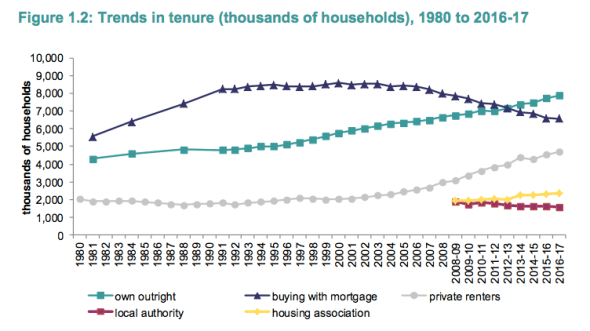
Figures in the 2016/17 English Housing Survey published on Thursday show yet another rise in the proportion of households renting from a private landlord and decline in home ownership.
More than 20% of us are now private renters, the highest figure in any year since 1969, the year of Woodstock and one small step for man.
Owner-occupation declined slightly from 62.9% to 62.6% but that overall figure conceals two very different trends.
The proportion of households who own outright rose again to 34.1% while the proportion buying with a mortgage fell to just 28.4%.
To put that second figure in perspective, throughout the 1990s more than 40% of us were buying with a mortgage.
Social renting remained stable at just over 17% of households, but with the local authority share of that falling again.
The long-term consequences of falling home ownership
Posted: November 12, 2017 Filed under: Home ownership, Housing benefit, Private renting, Welfare state | Tags: Generation Rent 4 CommentsA report today from Generation Rent predicts that the number of pensioner private renters will increase by 169% in England over the next 20 years at a cost of an extra £3.5bn in housing benefit.
The increase will come as a result of trends already hard-baked into the housing system and they have nothing to do with the people in their 20s and 30s that we are used to thinking of as Generation Rent.
Successive editions of the English Housing Survey (EHS) have shown that falls in home ownership are rippling up through the age bands as existing private renters get older and find themselves unable to buy.
The report by David Adler of Oxford University and Dan Wilson-Craw of Generation Rent looks at the current EHS, Office for National Statistics and housing benefit data to forecast what will happen by 2035/36.
There are currently 1.1 million private renter households aged between 45 and 64 who will reach retirement age in the next 20 years. Some of them will still be able to buy but on current trends 947,000 will be private renters into retirement.
Add another 50,000 current retiree households who will live into their 80s and you have a million who could be reliant on insecure short-term tenancies and potentially dependent on housing benefit. That could translate into an extra £3.5bn on top of the current housing benefit bill.

A system under strain
Posted: August 17, 2017 Filed under: Home ownership, Private renting, Social housing Leave a commentOriginally published as a column for Inside Housing on August 17.
Beneath the immediate crisis about a lack of new homes lies a long-running one about the homes that we have already built.
It’s hard to look much beyond the stat in a report published on Friday by the Local Government Association (LGA) that new homes built today will have to last 2,000 years at current rates of demolition and replacement.
Unless the output of the likes of Barratt and Taylor Wimpey is really going to stand for as long as some of the glories of Ancient Rome, something clearly does not add up. This graph shows the age of the stock broken down by tenure:

The report by Residential Analysts finds that large numbers of homes across all tenures are not of appropriate quality, with the private rented sector representing the biggest cause for concern, with problems such as damp and poor energy efficiency concentrated in the oldest stock.
The number of homes failing to meet the Decent Homes standard has been improving in recent years total cost of bringing them up to scratch is still estimated at £27 billion, of which just £2 billlion is for social housing.
The state of private renting
Posted: August 2, 2017 Filed under: Private renting | Tags: English Housing Survey Leave a commentOriginally published as a column for Inside Housing on August 2.
As home ownership and social renting continue to decline, the astonishing rise and rise of the private rented sector continues.
But who is the sector housing and what are the consequences for tenants? Here are a dozen key points that I picked out from the English Housing Survey for 2015/16.
1) Overall growth
One in five of us – 4.5 million households – now rent from a private landlord. That is 2.5 million more than in 2000.
2) Age
Growth continues to be fastest among young people as high house prices stop them buying and social housing is in short supply.
The proportion of 25 to 34 year olds renting from a private landlord has increased from 24% to 46% in the last ten years. As recently as 1991, just 12.9% of 25-34 year olds were private tenants.
That figure is for households, so it could well mask an even stronger growth in the number of individual young people renting as more of them share.
The average private renter household reference person (HRP – the oldest or highest-earning person in the households) is 40, making them much younger than social renters (52) and owner-occupiers (57).

However, since the financial crisis private renting has grown among all age groups, with sharp increases also seen among the 35-44s, 45-54s and 55-64s.
Housing insecurity takes centre stage
Posted: July 24, 2017 Filed under: Homelessness, Private renting, Temporary accommodation, Universal credit Leave a commentOriginally published as a column for Inside Housing on July 24.
Two reports over the weekend put housing insecurity firmly under the spotlight.
On Saturday the Local Government Association (LGA) made all the headlines when it highlighted the 120,000 children currently in temporary accommodation.
That’s not a new figure (it comes from homelessness statistics published a month ago) but that does not make it any less shocking. And the LGA puts it into real perspective by pointing out that the increase since 2014 is the equivalent of one secondary school full of children every month.
On Sunday, the Joseph Rowntree Foundation (JRF) published research looking at where much of that demand for temporary accommodation is coming from: evictions and forced moves from rented homes.
The report found that 40,000 tenants were evicted from their homes by landlords in 2015 and that private landlords are now carrying out more evictions than councils and housing associations.
That may not be much of a claim to fame for ‘social’ landlords but the rise in evictions reflects both the growth of the private rented sector and increasing use of Section 21 ‘no fault’ evictions by private landlords.
A look ahead to the manifestos
Posted: May 11, 2017 Filed under: Home ownership, Private renting, Tax | Tags: General Election 2017 Leave a commentOriginally posted on May 11 on my blog for Inside Housing.
As we await the manifestos, what are the chances of real change in housing over the next five years?
Give or take the odd leak, there are some positive signs. First, this election has one of the two major parties pinning its election hopes on housing reform and members of the other saying that ‘building more homes‘ is a bigger priority than it has been for years.
Second, a clutch of select committee reports, which were published just before parliament shut down for the election, set down some useful all-party markers for future policy.
Third, in Gavin Barwell and John Healey the two main parties have their best housing spokespeople in years. That may be damning them with faint praise but both seem to be politicians who get the case for housing.
 Jules Birch