Edinburgh 2017
Posted: August 23, 2017 Filed under: Culture | Tags: Edinburgh Festival 1 CommentEven at 70, the Edinburgh Festival just seems to keep getting bigger. Every time I go I think surely the expansion cannot continue but it does.
One big reason for that is that I should have said festivals rather than festival: the Edinburgh International Festival began in 1947 and continues to offer a programme at the highbrow end of the spectrum; the Fringe was started the same year by eight acts who were not allowed to take part but is now far bigger than the main event; the Book Festival is a relative youngster at 34; and the Free Festival began in 2004 as an alternative to the Fringe’s market economy. That’s not including the Film Festival and the Politics Festival, which used to be in August as well but have now moved to different times in the year.*
A second reason is that there can be few other cities in the world that have so many buildings that can be transformed into good venues. On top of the full-time theatres and concert halls and back rooms of pubs, there are countless university buildings, churches, chapels and halls and university buildings that can be used.
The irony is that the legacy of centuries of Edinburgh’s devotion to learning and Protestantism is an endless selection of places to buy an over-priced pint while toasting a statue of John Knox.
A system under strain
Posted: August 17, 2017 Filed under: Home ownership, Private renting, Social housing Leave a commentOriginally published as a column for Inside Housing on August 17.
Beneath the immediate crisis about a lack of new homes lies a long-running one about the homes that we have already built.
It’s hard to look much beyond the stat in a report published on Friday by the Local Government Association (LGA) that new homes built today will have to last 2,000 years at current rates of demolition and replacement.
Unless the output of the likes of Barratt and Taylor Wimpey is really going to stand for as long as some of the glories of Ancient Rome, something clearly does not add up. This graph shows the age of the stock broken down by tenure:

The report by Residential Analysts finds that large numbers of homes across all tenures are not of appropriate quality, with the private rented sector representing the biggest cause for concern, with problems such as damp and poor energy efficiency concentrated in the oldest stock.
The number of homes failing to meet the Decent Homes standard has been improving in recent years total cost of bringing them up to scratch is still estimated at £27 billion, of which just £2 billlion is for social housing.
Crisis warns of surge in homelessness
Posted: August 10, 2017 Filed under: Homelessness, Poverty, Prevention, Welfare reform | Tags: Crisis Leave a commentOriginally posted as a column for Inside Housing on August 10.
If the true scale of homelessness revealed in a report for Crisis is shocking enough now, try looking at the projections for the future.
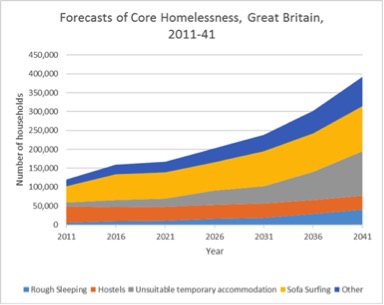
The report by Professor Glen Bramley of Heriot Watt University estimates that what it calls ‘core homelessness’ affected 160,000 households in 2016, an increase of a third since 2011.
That means that at any one time:
- 9,100 people were sleeping rough
- 68,300 households were sofa surfing
- 19,300 households were living in unsuitable temporary accommodation
- 37,200 households were living in hostels
- 26,000 households were living in other circumstances, including:
-
- 8,900 households sleeping in tents, cars or on public transport
- 12,100 households living in squats
- 5,000 households in women’s refuges or winter night shelters.
The report estimates that these include 57,000 families including 82,000 adults and 50,000 children, so that the total core homeless population is 236,000.
However, the total is forecast to rise by 76% in the next decade. After a steady rise to 167,000 households by 2021 the total is expected to accelerate over the to 238,000 by 2031 and 392,000 by 2041.
As the graph shows, the increases are expected to be especially sharp in unsuitable temporary accommodation, which includes bed and breakfast accommodation and out of area placements.
The day Mrs Thatcher came for tea
Posted: August 3, 2017 Filed under: London, Right to buy, Temporary accommodation | Tags: Dispossession, Havering 2 CommentsOriginally published as a column for Inside Housing on August 3.
If the Right to Buy has a birthplace it’s a terraced house at 39 Amersham Road in Harold Hill, near Romford in Essex.
True, the sale was the 12,000th rather than the first and 11 August, 1980 was not the actual birth date of the policy either.
However, both have come to symbolise the Right to Buy because this was the place and that was the day that Margaret Thatcher came for tea.
The former prime minister joined the Patterson family, who had bought their home for £8,315 after 18 years as tenants of the Greater London Council (GLC).
Two things came together to remind me of that photo opportunity this week: first, archive footage used in the film Dispossession (full review to follow soon); and second a good investigation by the local paper of hidden homelessness in the area.
The state of private renting
Posted: August 2, 2017 Filed under: Private renting | Tags: English Housing Survey Leave a commentOriginally published as a column for Inside Housing on August 2.
As home ownership and social renting continue to decline, the astonishing rise and rise of the private rented sector continues.
But who is the sector housing and what are the consequences for tenants? Here are a dozen key points that I picked out from the English Housing Survey for 2015/16.
1) Overall growth
One in five of us – 4.5 million households – now rent from a private landlord. That is 2.5 million more than in 2000.
2) Age
Growth continues to be fastest among young people as high house prices stop them buying and social housing is in short supply.
The proportion of 25 to 34 year olds renting from a private landlord has increased from 24% to 46% in the last ten years. As recently as 1991, just 12.9% of 25-34 year olds were private tenants.
That figure is for households, so it could well mask an even stronger growth in the number of individual young people renting as more of them share.
The average private renter household reference person (HRP – the oldest or highest-earning person in the households) is 40, making them much younger than social renters (52) and owner-occupiers (57).

However, since the financial crisis private renting has grown among all age groups, with sharp increases also seen among the 35-44s, 45-54s and 55-64s.
Housing insecurity takes centre stage
Posted: July 24, 2017 Filed under: Homelessness, Private renting, Temporary accommodation, Universal credit Leave a commentOriginally published as a column for Inside Housing on July 24.
Two reports over the weekend put housing insecurity firmly under the spotlight.
On Saturday the Local Government Association (LGA) made all the headlines when it highlighted the 120,000 children currently in temporary accommodation.
That’s not a new figure (it comes from homelessness statistics published a month ago) but that does not make it any less shocking. And the LGA puts it into real perspective by pointing out that the increase since 2014 is the equivalent of one secondary school full of children every month.
On Sunday, the Joseph Rowntree Foundation (JRF) published research looking at where much of that demand for temporary accommodation is coming from: evictions and forced moves from rented homes.
The report found that 40,000 tenants were evicted from their homes by landlords in 2015 and that private landlords are now carrying out more evictions than councils and housing associations.
That may not be much of a claim to fame for ‘social’ landlords but the rise in evictions reflects both the growth of the private rented sector and increasing use of Section 21 ‘no fault’ evictions by private landlords.
Finding new homes for Grenfell families
Posted: July 12, 2017 Filed under: Council housing, Local government, London | Tags: Grenfell Tower 1 CommentOriginally published as a column for Inside Housing on July 12.
How difficult should it be for Kensington and Chelsea to find new permanent homes for the families made homeless by the Grenfell Tower fire?
A month on from the disaster, new council leader Elizabeth Campbell promised on the Today programme this morning (listen from around 2:10:00) to build new council homes and buy existing ones.
So far 68 social rented homes have been reserved for the families at a new development in Kensington but they were always going to be affordable housing anyway, built under a Section 106 agreement and bought by the City of London Corporation.
Only 14 out of the 158 Grenfell families currently living in hotels have accepted offers of temporary accommodation as they wait for permanent homes.
Cllr Campbell, who is also the new cabinet member for housing and regeneration, gave a contrite but awkward interview in which she claimed (wrongly) that the Royal Borough would be the first in London to build new council homes and admitted (eventually) that she has never been inside one of the council’s tower blocks.
However, she did at least perform better than her predecessor as leader, Nick Paget-Brown, and another Tory councillor, Catherine Faulks, who made an embarrassing appearance on the same programme last week.
 Jules Birch