The political heat on association executive pay is off – for now
Posted: October 2, 2017 Filed under: Housing associations Leave a commentOriginally posted as a column for Inside Housing on October 2.
For the first time since I can remember average housing association chief executive pay has fallen in real terms.
After years of spurious justifications for bumper pay rises and bonuses that alone is enough to make this year’s Inside Housing salary survey worthy of note.
Beyond that, though, the arguments for and against high pay and the legacy of past increases remain largely the same as in any other year.
No, it’s impossible to defend one pay package of almost £600,000, four more of over £300,000 and another four of over £250,000 at a time when tenants face austerity, the bedroom tax and universal credit.
And, no, boards should not be pretending that they are only paying what the market demands when that market rate is set mostly by housing associations themselves.
What a way to run a housing system
Posted: September 14, 2017 Filed under: Help to Buy, Housebuilding, Social housing | Tags: UK Housing Review Leave a commentOriginally posted on September 14 as a column for Inside Housing.
The balance of funding between government funding for home ownership and affordable housing schemes continues to astonish even after the change in emphasis under Theresa May.
Revised figures prepared for Thursday’s publication of the UK Housing Review Briefing Paper show that total support for the private market up to 2020/21 is set to total £32 bn compared to support for affordable housing investment of just £8.6 bn.
This pie chart really brings it home:
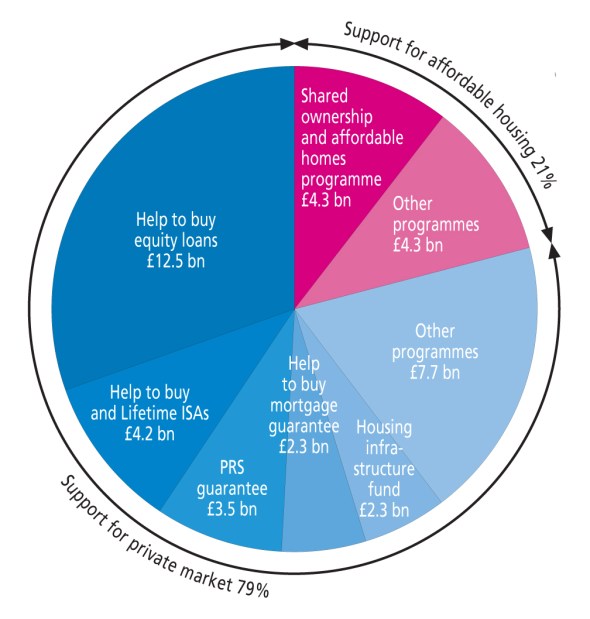
These are revised figures that take account of the extra money for affordable housing announced by chancellor Philip Hammond last November. Even after that, even after adjustments for lower than expected spending on mortgage guarantees, and even including the Right to Buy pilot in the pink part of the graph, we are still spending £4 on support for the private market for every £1 we spend on support for affordable housing.
What really leapt off the page at me in this chart was that the government is set to spend £4.2 bn on Help to Buy and Lifetime Individual Savings Accounts (ISAs) over the same period as it spends £4.3 bn on the main Shared Ownership and Affordable Homes programme.
Radio review: Streets Apart
Posted: September 11, 2017 Filed under: History, Right to buy, Social housing Leave a commentOriginally posted as a column for Inside Housing on September 11.
In case you missed it, you still have chance to catch up with a superb history of social housing that ran over the last two weeks on Radio 4.
Lynsey Hanley’s Streets Apart told the story from the beginning of council housing in the 19th Century in Liverpool to the present. I got the impression that most of it was made before the fire at Grenfell Tower, but its shadow looms over everything.
Why is the series so good? Partly that Lynsey Hanley knows what she is talking about (as author of Estates: An Intimate History and Respectable: The Experience of Class). She is also an engaging presenter with an accent not normally heard on Radio 4 that comes from her upbringing on the Chelmsley Wood estate in Solihull.
Partly because her interviewees know what they are talking about: they are a mixture of experts in local areas, in architecture, planning and housing and local residents who are given time to tell their stories.

But also because she recognises the nuances and contradictions in the history of social housing and in its present: Michael Heseltine comes out of it surprisingly well for the minister who introduced the Right to Buy; another Tory minister Harold Macmillan gets the last word; and the final episode features more than one side to current regeneration controversies.
Her message may be obvious in one sense and, as she says, naïve and utopian in another: in the wake of Grenfell Tower, housing needs the same national priority as health and education.
But the thesis behind it is also a challenge to those of us who would agree with all of that: ‘Social housing in Britain has suffered from the flaw of being regarded as being only for poor and working class people and not for everyone.’
The state of owner-occupation
Posted: September 5, 2017 Filed under: Home ownership, Mortgages | Tags: English Housing Survey Leave a commentOriginally published as a column for Inside Housing on September 5.
The decline of owner-occupation in England resumed in 2015/16 after a brief uptick in the previous year.
The English Housing Survey shows that owner-occupation as a whole fell below 63% to return it to levels last seen in 1985, when the Right to Buy and Margaret Thatcher’s drive for a property-owning democracy were in full flow. The ownership rate is now down eight percentage points on its peak in 2003.
However, even that conceals the full scale of the decline. Owner-occupation is made up of two very different groups – people who own their home outright and those who are buying with a mortgage – and the split between them has changed radically over time.
Here are some key points that I picked out from the English Housing Survey for 2015/16:
1) Owning’s rise…
Outright ownership is still rising as people who first took out a mortgage 25 years or more ago pay it off. From 25% of households (4.5 million) in Mrs Thatcher’s heyday, it has grown to overtake mortgaged ownership two years ago and reach 34% (7.7 million) in 2015/16.
Simple ‘solutions’ plague our thinking about housing
Posted: August 29, 2017 Filed under: Home ownership, Housebuilding, Planning | Tags: Analysis Leave a commentOriginally published as a column for Inside Housing on August 29.
‘What makes the housing crisis so maddening is that there is a simple solution: Britain needs to get building.’
So ran a tweet a couple of weeks ago from The Economist about an article on How to Solve Britain’s Crisis. Unleash the market, build on the green belt and, hey presto, the housing crisis is over.
In fairness, the article’s proposition was a bit more complicated than the tweet implied – it also proposed reform of stamp duty and council tax – but it is still an illustration of the way that ‘simple solutions’ plague our thinking about housing.
What I mean by that is that there may well be good arguments that can be made for building on the green belt, or rent control, or building a million council houses, or prefabrication or any of the other quick fixes that are routinely trotted out.
It’s certainly hard to see a solution that does not involve more homes, better conditions for private renters, a greater role for local authorities and innovations in construction.
However, it’s quite different when one of them is proposed as the solution. Usually this is by one of the ‘unleash the market’ brigade who believe that the housing crisis is all down to planning.
Edinburgh 2017
Posted: August 23, 2017 Filed under: Culture | Tags: Edinburgh Festival 1 CommentEven at 70, the Edinburgh Festival just seems to keep getting bigger. Every time I go I think surely the expansion cannot continue but it does.
One big reason for that is that I should have said festivals rather than festival: the Edinburgh International Festival began in 1947 and continues to offer a programme at the highbrow end of the spectrum; the Fringe was started the same year by eight acts who were not allowed to take part but is now far bigger than the main event; the Book Festival is a relative youngster at 34; and the Free Festival began in 2004 as an alternative to the Fringe’s market economy. That’s not including the Film Festival and the Politics Festival, which used to be in August as well but have now moved to different times in the year.*
A second reason is that there can be few other cities in the world that have so many buildings that can be transformed into good venues. On top of the full-time theatres and concert halls and back rooms of pubs, there are countless university buildings, churches, chapels and halls and university buildings that can be used.
The irony is that the legacy of centuries of Edinburgh’s devotion to learning and Protestantism is an endless selection of places to buy an over-priced pint while toasting a statue of John Knox.
A system under strain
Posted: August 17, 2017 Filed under: Home ownership, Private renting, Social housing Leave a commentOriginally published as a column for Inside Housing on August 17.
Beneath the immediate crisis about a lack of new homes lies a long-running one about the homes that we have already built.
It’s hard to look much beyond the stat in a report published on Friday by the Local Government Association (LGA) that new homes built today will have to last 2,000 years at current rates of demolition and replacement.
Unless the output of the likes of Barratt and Taylor Wimpey is really going to stand for as long as some of the glories of Ancient Rome, something clearly does not add up. This graph shows the age of the stock broken down by tenure:

The report by Residential Analysts finds that large numbers of homes across all tenures are not of appropriate quality, with the private rented sector representing the biggest cause for concern, with problems such as damp and poor energy efficiency concentrated in the oldest stock.
The number of homes failing to meet the Decent Homes standard has been improving in recent years total cost of bringing them up to scratch is still estimated at £27 billion, of which just £2 billlion is for social housing.

