Johnson, Partygate and manifesto commitments
Posted: January 31, 2022 Filed under: First Homes, Home ownership, Homelessness, Housebuilding, Levelling up | Tags: Boris Johnson Leave a commentOriginally written as a column for Inside Housing.
It’s been just over two years but thanks to Covid-19 it feels like a lifetime ago.
Leaving aside the question of whether he has really delivered on his headline promise to ‘Get Brexit Done’ how much of Boris Johnson’s 2019 election manifesto has survived into the post-Coronavirus age?
The question was originally prompted by the outcome of the judicial review over Everyone In. The scheme launched at the start of the pandemic to get rough sleepers off the streets and into hotels within a few days was a great success.
It also signalled that the manifesto promise to ‘end the blight of rough sleeping by the end of the next parliament’ should be well within reach.
Except that, for all that rhetoric, Everyone In morphed from a policy into an initiative with an asterisk attached. From around May 2020, it was no longer a promise but branding for an initiative exhorting local authorities to act without giving them any extra resources.
And then I realised the wider context as we continue the seemingly interminable wait for Sue Gray’s report.
Read the rest of this entry »The ‘problem of rent’ has just got worse
Posted: January 25, 2022 Filed under: Housing benefit, Welfare state | Tags: Beveridge, Joseph Rowntree Foundation, Resolution Foundation Leave a commentOriginally written as a column for Inside Housing.
The UK has among the lowest levels of basic benefits in the developed world but spends more than any other country on housing benefits.
The two statements, which come from a new report by the Resolution Foundation, are of course connected and they are the result of deliberate policy choices over decades.
The first relates to the way that the benefits system evolved in the wake of the Beveridge report with low levels of working-age benefits supplemented by extra support for housing, children and ill-health.
Beveridge had confessed that he was unable to solve what he called ‘the problem of rent’ – how you account for housing costs that vary between different areas – in his blueprint for social security after the Second World War.
His fudged solution was to add a flat rate housing allowance to contributory unemployment benefit but that was rejected in favour of means testing in the scheme that was introduced.
However, his whole report was written on the assumptions that full employment, mass council housebuilding and private sector rent control would continue.
By contrast, most European countries have more generous contributory and earnings-related benefits supplemented by a means-tested safety net.
This graph from the report shows the difference:

For clarity it’s worth pointing out that this is based on the OECD definition of housing benefits in kind, which includes payments for housing costs but not mortgage tax relief (still paid in some countries) or capital investment in social housing or the ‘subsidy’ of the lower rents it produces.
The second policy choice dates back to the deregulation of rents and decline of social housing in the 80s and 90s – reversing those assumptions made by Beveridge – and more recent falls in home ownership among low-income households that have left them paying higher rents.
Read the rest of this entry »Gove’s grand plan leaves gaps to fill
Posted: January 17, 2022 Filed under: Fire safety, Help to Buy, Housebuilding | Tags: Michael Gove Leave a commentAs one MP put it, we welcome the steps forward in ministerial statements on building safety only to find problems in the steps backward that follow.
Michael Gove’s plans to ‘make developers pay’ represent the most positive steps seen so far but there are still major concerns over what comes next.
For starters, how exactly will he ‘make’ them? The initial plan in talks before Easter seems to be persuasion but the levelling up secretary has limited levers that he can pull and why would companies that have previously resisted calls to ‘do the right thing’ change their minds now?
He cited the way that Rydon Homes, sister company of the main contractor in the Grenfell refurbishment, was barred from Help to Buy but the scheme ends in 2023 and most of the £29 billion in equity loans has already been committed.
This highlights yet again a major flaw in the government’s support for housebuilders that I highlighted even before the creation of Help to Buy: its failure to get a quid pro quo for all that help for profits, bonuses and dividends.
Short of another support scheme, which may ironically be needed if supply plummets, that leaves blacklisting from Homes England programmes and naming and shaming as his principal weapons. Neither is a negligible threat but will they be enough?
That leaves coercion, legal action or the ‘high-level threat’ of a new tax that Gove is authorised to make in the letter leaked to Newsnight from chief secretary to the Treasury Simon Clarke.
Read the rest of this entry »Crazy lending v insane housing system
Posted: January 4, 2022 Filed under: Uncategorized Leave a commentOriginally written as a column for Inside Housing.
It sounds crazy and it is. New mortgages at up to seven times a person’s income look like a reminder of the excessively loose lending seen before the financial crisis and the collapse of Northern Rock.
At the end of a year in which house prices have risen at their fastest rate since 2006 and interest rates began to rise from record lows, and at the start of one in which household incomes face a squeeze, the timing of the new deal from online broker Habito looks, shall we say, interesting.
Take that seven times income and add five times a partner’s salary and a couple each earning £25,000 could borrow £300,000 to buy a £330,000 home, well above the Nationwide’s new UK average of £255,000. Take out the loan for 40 years rather than the traditional 25 and they can reduce their monthly payments too.
Read the rest of this entry »The £3 trillion question
Posted: December 10, 2021 Filed under: Housing market, Inequality, Tax | Tags: Resolution Foundation Leave a commentOriginally written as a column for Inside Housing.
It has so many zeros in it that it’s worth writing it out in full: £3,000,000,000,000.
That’s the increase in the housing wealth of British households since 2000, according to new analysis from the Resolution Foundation. Perhaps even more remarkably, as the graph below shows, around half of that has been (un)earned since 2012, in the wake of a Global Financial Crisis that seemed set to bring the whole market crashing down.
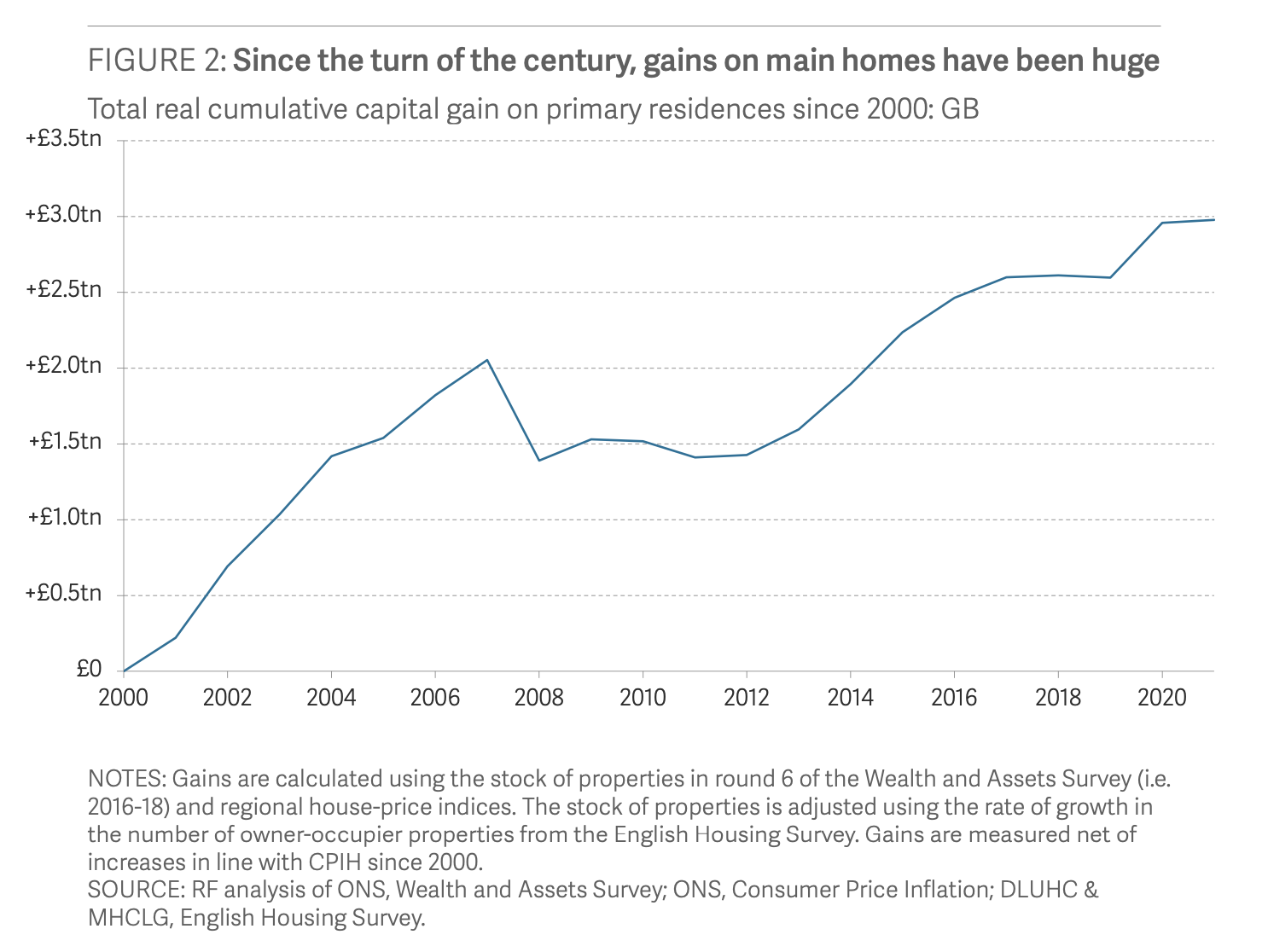
The distribution of all that housing wealth has been startlingly unequal. Londoners gained almost four times as much (£76,000) as those in the North East (£21,000) and the over-65s eight times as much as 30-34 year olds and more than three times as much as 35-39 year olds.
Where the least wealthy third of households gained less than £1,000 per adult, the wealthiest 10 per cent chalked up an average gain of £174,000.

Needless to say, the gains for anyone who has remained a social tenant or a private renter are zero and zero – and less than zero for leaseholders unlucky enough to be stuck in unmortgageable and unsaleable flats.
Read the rest of this entry »How sorry is ‘deeply sorry’?
Posted: December 9, 2021 Filed under: Fire safety, Grenfell Tower | Tags: DLUHC Leave a commentOriginally published as a column for Inside Housing.
Where does the buck stop? It’s the question that has hung over much of the Grenfell Tower inquiry ever since phase two opened with what lead counsel Richard Millett called a ‘merry-go-round of buck passing’ between the organisations and companies involved.
The opening statements in the latest part of module 6 this week take us at last to where, how and why decisions were made within government.
The Department for Levelling Up, Housing and Communities (DLUHC) admits in its opening statement that it ‘presided over an overarching building safety system that has been shown to be unfit for purpose with catastrophic consequences’.
It acknowledges a series of failures in its oversight of the regulatory system, internal governance, and the nature of its responses to the recommendations of the Lakanal House coroner and issues raised by the All-Party Parliamentary Group (APPG) on fire safety.
And it says that: ‘Cumulatively these failings helped to create an environment in which non-compliance was widespread and such a tragedy was possible. For that it is deeply sorry.’
Read the rest of this entry »Parallel scandals
Posted: December 1, 2021 Filed under: Fire safety, Leasehold | Tags: Michael Gove Leave a commentOriginally written as a column for Inside Housing.
The building safety and leasehold scandals have run in tandem for some time but the parallels really hit home in parliament this week.
The parallels between the two issues go well beyond the fact that both concern leaseholders and the power imbalance between them and freeholders.
While the government is acting to change things for the future, progress on protecting existing leaseholders and residents of buildings with safety issues has been slow. Ministers have repeatedly promised action only to lament the complexities of the issues involved.
Building safety dominated the initial exchanges in Commons questions on Monday as MP after MP asked Michael Gove about the plight of leaseholders in their constituencies.
The levelling up secretary dropped yet more hints of a series of new measures to tackle the ‘invidious vice’ in which leaseholders are caught that will be announced ‘shortly’, ‘in due course’ and eventually ‘before Christmas’.
Adopting the more aggressive tone towards developers and the construction industry that has marked his approach to the issue since the reshuffle, he said that ‘my Department are looking at every available means to ensure that the burden is lifted from leaseholders’ shoulders and placed where it truly belongs’.
Read the rest of this entry »Cutting the Goveian knot
Posted: November 9, 2021 Filed under: Fire safety, Levelling up, Planning, Social housing Leave a commentOriginally published on November 10 as a column for Inside Housing.
In a two-hour appearance before MPs, Michael Gove made most of the right noises but can he really come up with meaningful solutions to the intractable problems that come with his new job?
The man in charge of the Department for Levelling Up, Housing and Communities (DLUHC) was facing questions from what is still called the Housing, Communities and Local Government Committee. You can watch it back here.
The reorganisation of his department added responsibilities for levelling up and preserving the union to the tangled threads of building safety, planning, home ownership and homelessness that were already crowding his in-tray. You might almost call it a Goveian Knot.
What was striking was not just Mr Gove’s willingness to engage with committee members but also his multiple hints of bolder answers on the way.
The levelling up secretary signalled pauses and rethinks and resets on several of the most contentious issues he faces. This is reflected in this morning’s press coverage of his hints that housebuilding targets will be scrapped, his pledge that controversial fire safety advice will be withdrawn soon and his criticism of ‘overcautious’ lending by banks to first-time buyers.
It also became clear that he sees a direct link between levelling up and the H side of his brief.


