Originally written as a column for Inside Housing.
So where next? The publication of the UK Housing Review this week is a chance to take stock and ask where the housing system may be heading.
The sense is one of considerable flux, for home ownership as the housing market downturn continues, for private renting as the momentum behind increased regulation grows and for social housing as landlords face competing demands for scarce resources.
The paralysis of policy signalled by a Budget that mostly ignored housing could be just a temporary lull ahead of a UK general election.
As ever, the review puts all that into context. For starters, John Perry’s chapter on housing expenditure shows where total government support (in grants, loans and guarantees) for housing is going. The balance between the private market (59 per cent) and affordable housing (41 per cent) may not be quite as skewed as it was in the heyday of Help to Buy but it is still tilted in one direction.
The good news is that public spending on affordable homes has risen in real terms since the dark days of the coalition government. Investment under three Affordable Homes Programmes is set to peak this year – but the looming cliff edge is an indication of the big decisions that lie ahead:
Current spending plans (as in the Budget) rely on eye-watering (and unrealistic) austerity after the next election so that they comply with the chancellor’s fiscal rules. Key decisions lie ahead in the spending review after the next election regardless of who wins.
What is getting built is also skewed. There were 59,175 affordable housing completions in England in 2021/22, the highest for 11 years. However, more than 20,000 of those were for affordable home ownership and 28,000 for affordable rent, leaving just 7,528 for social rent (plus another 3,080 for similar London Affordable Rent).
Contrast that with Scotland, which managed 9,757 affordable completions in 2021/22 including almost as many social rent homes (7,306) despite having a population about a tenth of England’s.
Originally written as a column for Inside Housing.
‘Making things right’ is the government’s theme of the month for housing and two new pieces of legislation represent significant steps in that direction.
Unfortunately they also beg some real questions about what’s happening, and not happening, elsewhere.
The Social Housing (Regulation) Bill passed its final hurdle before Royal Assent with its third reading in the Commons on March 1. The proactive consumer regulation regime and inspections that were dropped in 2010 will now be restored.
While its long-term impact remains to be seen, the Bill was considerably strengthened by last-minute government amendments to implement ‘Awaab’s Law’ time limits for landlords to investigate and fix damp and mould problems and to mandate professional standards for social housing staff.
The private member’s bill introduced by Conservative MP Bob Blackman (also the architect of the Homelessness Reduction Act in 2017) aims to stop the exploitation of vulnerable tenants by rogue landlords in the exempt accommodation sector.
The two Bills, and the spirt of cooperation in the debates on them, highlight a significant change in attitudes within government since Grenfell.
Originally written as a column for Inside Housing.
Why has housing become so unaffordable over the last 40 years?
The answer, according to new report for the Joseph Rowntree Foundation (JRF), is cuts in housing subsidy that represent ‘a massive shift in who pays market housing costs, from government and landlords onto tenant’ since 1979.
It’s the scale of the shift, rather than the shift itself, that is striking.
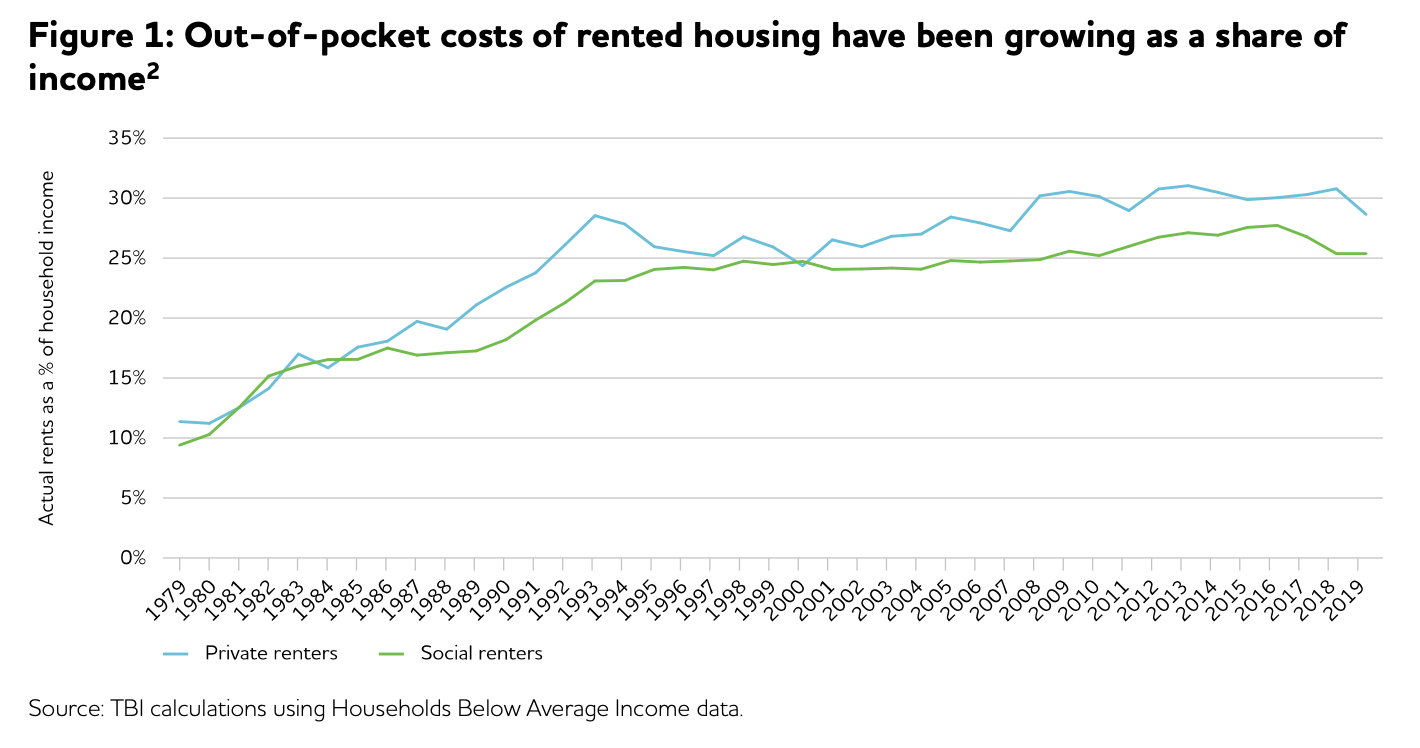
Back at the start of Margaret Thatcher’s first term, social and private renters alike were paying around 10 per cent of their incomes on rent. By 2020 that had risen to 25 per cent for social renters and 30 per cent for private renters.
The shift is represented in a graph that Ian Mulheirn, who co-authored the report with colleagues James Browne and Christos Tsoukalis from the Tony Blair Institute for Global Change, calls ‘one of the most striking’ in public policy:
They calculate that if housing subsidies had been maintained at 1979 levels as a share of total housing costs they would have been worth £45 billion 2019/20 rather than the actual £31 billion.
This ‘generational housing costs squeeze’ is the result of massive change in three elements of housing subsidy: social housing; housing benefit; and rent controls.
That is the result of the accumulation of many different policies over time: cuts in investment in council housing and higher council rents; private finance and higher housing association rents; the deregulation of the private rented sector; and rapid increases in housing benefit to ‘take the strain’ of all that followed by the cuts imposed under austerity.
At first glance there is nothing especially radical about the Better Social Housing Review – as the independent panel says, ‘there is nothing revelatory in our findings’ and ‘it may seem to housing associations that our recommendations are already central to their approach’.
And indeed much of what the review commissioned by the National Housing Federation and Chartered Institute of Housing says about engaging tenants, improving repairs services, handling complaints better and tackling stigma and discrimination are things that landlords could, and should, already be doing.
But take a second look and the key messages about organisations focussing on their core purpose and about it being ‘time to get back to basics’ are profoundly radical. They represent a challenge to the way that the sector has developed in the three decades since housing associations became the alternative to what the Conservative government called the ‘municipal monopoly’.
Because that same government was also making associations the vehicle for private finance and stock transfer and steadily squeezing the grant rate for new development to encourage them to ‘sweat their assets’.
That drive for ever greater efficiency and value for money worked in the sense that it delivered more new homes for less public money but it also created a remorseless logic for merger and the creation of landlords that became even bigger than the giant council housing departments of the past.
And that was only reinforced by regulatory changes in 2010 that overwhelmingly prioritised financial concerns over consumer ones and encouraged landlords to focus accordingly.
Originally written as a column for Inside Housing.
Eight weeks after Liz Truss and Kwasi Kwarteng shrank the economy with their growth plan, chancellor Jeremy Hunt completed his reversal of almost all of their plans in his Autumn Statement.
He was speaking against a backdrop of dire forecasts of recession, unemployment, falling living standards and rising taxes that spoke of bad news to come for housing and tenants and landlords alike.
The complete rewrite of the Autumn Statement leaves a long list of tax increases and spending cuts in its wake, even if many of them will not take effect until after the next election and so may not happen. However, there was still a little hope amidst the gloom.
Here are five points I picked up from the statement itself and the background documents.
The cap and the freeze
Perhaps the most surprising thing about the statement – with a nod to expectations management by the Treasury – is that there is also some good news. The announcement that the government will stick to previous pledges to increase benefits (and pensions and the minimum wage) in line with prices was not completely unexpected but will still come as a relief to tenants and landlords alike.
But Jeremy Hunt’s decision to increase the overall benefit caps by the same amount is much more of a surprise. Without this, thousands more households faced being capped as their benefits rose to hit thresholds that have been frozen since they were cut in 2016. The main thresholds for families will now increase to £22,020 a year outside London and £25,323 in the capital. The cost is estimated at £315 million in 2023/24 and almost £2 billion over the next five years.
And yet… these are still far below the average earnings figures that were misleadingly used to justify the cap in the first place. And they leave people who are already capped facing rent increases with no extra income to pay for them.
Finally, buried deep in the background documents is more gloom: the assumption that Local Housing Allowance rates for private renters will remain at 2022/23 levels, which have themselves been frozen since April 2020. This despite rapidly rising rents. If confirmed, the result will inevitably be rising rent arrears and homelessness.
Originally written as a column for Inside Housing.
The UK Housing Review Autumn Briefing Paper is published this week and as usual provides an invaluable guide to the state of the housing nation. Here are five graphs that illustrate key points about five different parts of the housing system:
Shifting rules on rents
What everyone wants to know, of course, is what will come in place of that purple line on the right but the graph is a reminder that so-called long-term deals on social housing rents can quickly disappear. The four-year rent reduction at the end of the 2020s that ended the previous one is now set to be succeeded by an annual increase significantly below the 11.1 per cent implied by the CPI plus 1 formula.
The Briefing Paper quotes estimates by Savills that a 5 per cent cap on rents in England (the government’s favoured option) would cost councils £500 million and housing associations up to £1 billion. One association says that even a 7 per cent cap would mean a 21 per cent reduction in new build and there are also major concerns about the impact on investment in existing stock and on supported housing.
A cap would help tenants not on housing benefit but the major beneficiary would be the Department for Work and Pensions unless its savings are reinvested in housing.
That point was really brought home to me when I interviewed the Welsh housing minister recently. She was only too aware that the more she restricts next year’s rent increase, as might be her instinct, the more savings will go straight back to Westminster, with zero chance of them coming back to Wales.
Originally published as a column for Inside Housing.
Austerity is back. The mess left by Liz Truss and Kwasi Kwarteng will have to be cleaned up, constraining the options for Rishi Sunak and for whoever wins the next general election.
But there is nothing that says Austerity 2.0 has to be a repeat of the 2010s. Treasury orthodoxy is in charge again but there are always political choices.
David Cameron and George Osborne chose to prioritise cuts in public services and benefits over tax rises but that will be more difficult for a prime minister taking office at a time when those services are collapsing and benefits are already close to destitution levels.
And there is one more crucial difference this time around: in the 2010s austerity was accompanied by record low interest rates that slashed mortgage payments for millions of home owners and buy-to-let landlords.
The benefits flowing to anyone with a mortgage – and to existing owners as house prices rose – help to explain why the Conservatives have won four elections in a row.
But Austerity 2.0 arrives just as mortgage rates are rising and just as the prospects of a housing market downturn are shifting from likely to inevitable.
Originally published as a column for Inside Housing.
Simon Clarke has yet to reveal much of his thinking on the key issues facing his new department but the early signals coming from the new government mean it’s already clear that tough choices lie ahead.
As chief secretary to the Treasury since September 2021 he was responsible for scrutinising and departmental requests for more public spending. Now he replaces Greg Clark at the Department for Levelling Up, Housing and Communities (DLUHC), where he briefly served as a minister for regional growth and local government in 2020.
As a prominent supporter of Liz Truss, Clarke will have some influence with the prime minister and could be heard acting as her spokesman on energy costs on the Today programme on Thursday.
Like any secretary of state he will fight for the departmental interest and but it seems doubtful whether he will have as much heft in Whitehall as his predecessor but one Michael Gove.
Indeed there are already some straws in the wind. Consider a story leaked to the Telegraph over the weekend about a £1.5bn underspend at the DLUHC.
Originally published as a column for Inside Housing.
The rent cap proposed for social housing may not have come as a huge surprise but the consequences will play out in very different ways for different parties.
It says it all about the cost of living crisis that whether rents are capped or not could be well down social tenants’ list of worries over the next few months.
The energy price cap has already almost doubled in the last 12 months to £1,971 a year. Next month that will rise to £3,549 and the worst forecasts suggest that could double again by next April unless the new government takes radical action.
Effectively, therefore, tenants in social housing could be paying double rent next year unless they take drastic steps to cut their bills.
But many are already doing this and finding that even turning the boiler off does not go far enough – they may be asking why the consultation does not include an option to freeze rents.
The problem is that, while supply has to be part of the solution, it takes time to have an effect and people who need affordable homes do not have time.
Even if we built 300,000 new homes a year in England (an even bigger if as Tory leadership candidates pander to their MPs and members) that would have to be sustained for years to have an impact on prices. Even if that included the 90,000 social rent homes a year advocated by campaigners, and even if no more were sold off, it would take more than a decade to house families on council waiting lists that significantly understate demand.
So why not look instead at the 25 million homes that already exist? As Darren Baxter-Clow, Joseph Elliott and Rachelle Earwalker argue in the paper, recent history shows that rapid changes are possible.


 Jules Birch