Where the money really goes in housing
Posted: March 21, 2018 Filed under: Affordable housing, Help to Buy, Home ownership, Housing benefit, Private renting, Social housing | Tags: UK Housing Review Leave a commentThree comparisons leap out from the latest edition of the indispensable UK Housing Review published on Wednesday.
The first two are not new in themselves and the third is only a crude estimate but all three need repeating again and again for a real appreciation of where spending on housing goes and exactly who is subsidising who.
First comes the main one highlighted by the Chartered Institute of Housing (CIH): the shift from bricks and mortar to personal subsidies, or from grants for new homes and repairs to old ones to housing benefit.
This series of pie charts from the Review shows the change over the last 40 years and the total amount of housing subsidies in real terms:

Note first that supply subsidies have sunk to just 4.3 per cent of the total pie – this despite all the cuts in housing benefit seen since 2010 and the fact that the figures to not include continuing tax reliefs for home owners (see below for more on that).
Second, note that this does not save money. Total subsidies are now 48 per cent higher in real terms than at the turn of the century (when admittedly social housing investment was very low) but they are also approaching the levels of 30 years ago (when investment was significantly higher and the unemployment rate was three times what it is now).
Age, class and home ownership
Posted: February 16, 2018 Filed under: Home ownership, Inequality, Mortgages | Tags: IFS, Resolution Foundation Leave a commentOriginally published on my blog for Inside Housing on February 16.
Housing is so often presented as a story of inequality between the generations but what about inequality within generations?
Analysis published on Friday by the Institute for Fiscal Studies confirms the familiar story of the collapse of home ownership among younger people that has been accompanied by a surge in private renting and adults still living with their parents into their late 20s and early 30s.

The IFS briefing concentrates on people aged 25-34, exactly the age group who could once have been expecting to take their first step on to the housing ladder.
The collapse has obviously been biggest in London but home ownership rates have fallen even in the cheapest regions like the North East and Cumbria.

Look beyond the rate rise for the real housing squeeze
Posted: November 2, 2017 Filed under: Benefit cap, Mortgages, Poverty, Uncategorized Leave a commentOriginally posted as a column for Inside Housing on November 2.
Today’s first rise in interest rates for a decade is an important symbolic moment but it will make little or no immediate difference to the housing costs of millions of home owners with a mortgage.
The increase from 0.25% to 0.5% could see average mortgage payments rise by around £15 a month but it will not apply straight away to people with fixed rate mortgages and in any case it only restores the base rate to what was a record low between 2009 and the aftermath of the referendum.
Compare that with the continuing squeeze on benefits and tax credits/universal credit that the Institute for Fiscal Studies forecasts today will help to increase the percentage of children in relative poverty after housing costs from 30% now to 37% by 2022.
And contrast it with the latest overall benefit cap statistics also published today: as at August 68,000 families were hit by the lower cap that came into effect a year ago and nearly a third of them are losing between £50 and £100 a week. The cap is now £26,000 in London and £20,000 elsewhere.
What a way to run a housing system
Posted: September 14, 2017 Filed under: Help to Buy, Housebuilding, Social housing | Tags: UK Housing Review Leave a commentOriginally posted on September 14 as a column for Inside Housing.
The balance of funding between government funding for home ownership and affordable housing schemes continues to astonish even after the change in emphasis under Theresa May.
Revised figures prepared for Thursday’s publication of the UK Housing Review Briefing Paper show that total support for the private market up to 2020/21 is set to total £32 bn compared to support for affordable housing investment of just £8.6 bn.
This pie chart really brings it home:
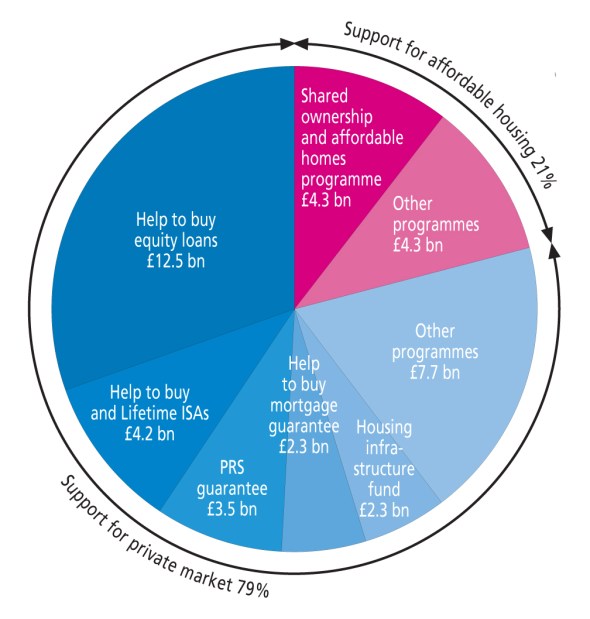
These are revised figures that take account of the extra money for affordable housing announced by chancellor Philip Hammond last November. Even after that, even after adjustments for lower than expected spending on mortgage guarantees, and even including the Right to Buy pilot in the pink part of the graph, we are still spending £4 on support for the private market for every £1 we spend on support for affordable housing.
What really leapt off the page at me in this chart was that the government is set to spend £4.2 bn on Help to Buy and Lifetime Individual Savings Accounts (ISAs) over the same period as it spends £4.3 bn on the main Shared Ownership and Affordable Homes programme.
The state of owner-occupation
Posted: September 5, 2017 Filed under: Home ownership, Mortgages | Tags: English Housing Survey Leave a commentOriginally published as a column for Inside Housing on September 5.
The decline of owner-occupation in England resumed in 2015/16 after a brief uptick in the previous year.
The English Housing Survey shows that owner-occupation as a whole fell below 63% to return it to levels last seen in 1985, when the Right to Buy and Margaret Thatcher’s drive for a property-owning democracy were in full flow. The ownership rate is now down eight percentage points on its peak in 2003.
However, even that conceals the full scale of the decline. Owner-occupation is made up of two very different groups – people who own their home outright and those who are buying with a mortgage – and the split between them has changed radically over time.
Here are some key points that I picked out from the English Housing Survey for 2015/16:
1) Owning’s rise…
Outright ownership is still rising as people who first took out a mortgage 25 years or more ago pay it off. From 25% of households (4.5 million) in Mrs Thatcher’s heyday, it has grown to overtake mortgaged ownership two years ago and reach 34% (7.7 million) in 2015/16.
Book review: The Financialization of Housing
Posted: November 13, 2016 Filed under: Financialisation, Housing market, Mortgages, Private renting, Regulation, Social housing | Tags: Manuel Aalbers Leave a commentThe Global Financial Crisis was a wake-up call to the world about the dangers posed by a toxic mix of finance and housing, one that has still not been properly heeded.
The mortgage-backed securities, collaterialised debt obligations and other financial instruments that financed the expansion of sub-prime and predatory lending were the result of a wave of innovation by a finance industry that had been deregulated over the previous 20 years. Britain marked the 30th anniversary of the Big Bang in the City last month but similar things happened around the developed world.
All that innovation and securitisation led to exponential increases in the amount of credit circulating within the financial system but it still needed something to be secured against. Which is where housing came in: a mortgage finance system that had been based on long-term mortgage lending funded from savings was transformed into a vehicle for the expansion of credit. And the relationship between the price of homes and the earnings of people buying them was also transformed.

The Financializaton of Housing: A Political Economy Approach, a new book by Manuel Aalbers, is the most comprehensive attempt I’ve seen to outline this process and its consequences. It’s part of a multinational research project based at the University of Leuven in Belgium on what he calls the Real Estate/Financial Complex in 12 different countries around the world. The metaphor is a deliberate echo of the military/industrial complex and serves to emphasise the connections not just between the real estate and financial sectors but also between each of them and the state.
Off target
Posted: August 24, 2016 Filed under: Help to Buy, Housebuilding Leave a commentOriginally posted on August 24 on Inside Edge 2, my blog for Inside Housing
A million new homes by 2020? The latest housebuilding statistics for England suggest little progress towards the government’s target or aspiration or ambition. I forget which it is this week.
There’s the usual mix of good news (starts up slightly on the previous quarter and last year) and bad (completions up on the previous quarter, down a bit on last year).
But is this graph shows there are few signs of a step change in output. After an uptick in 2013/14, starts have now been stuck on just over 140,000 for the last nine quarters. Completions have now caught up.

And this is before any real impact from the Brexit referendum. Projections by Capital Economics in a report by Shelter yesterday suggest that housebuilding will fall by 8% over the next year because of uncertainty following the vote and that output will be down 66,000 homes as a result.
So a year into that five-year non-target, it seems perfect timing for chancellor Philip Hammond to launch his much-touted fiscal stimulus in the Autumn.
 Jules Birch